Showing posts with label Sweden. Show all posts

Wednesday, 29 January 2025

Now in Maximum Mini Newsletter #60


Background discovery: the crashed Mini Marcos of the 1967 Targa Florio


Peter Sellers and the Unipower GT 

Mystery Mini derivative (89)
Tuesday, 4 June 2024

Now in Maximum Mini Newsletter #27


Fireball Midget - background now finally revealed 

New historical pictures of Swedish Cox GTM emerge

Another look back at Jeremy Delmar-Morgan

Tuesday, 28 May 2024

Now in Maximum Mini Newsletter #26


Raced, lost, found and now for sale: Dagobert's Cox GTM 

Heerey GTM found in... the USA

Mini Jem prototype in historical track test

Thursday, 13 April 2023

The Targa Florio Mini Marcos (4)

Over to the 4th and (for now) final episode about the Mini Marcos that made it (briefly) to the 1967 Targa Florio (for part 1 click here, part 2 here, part 3 here)

Our Swedish Marcos-man Per Haegermark wrote earlier: "Before I can tell you with 100% certainty that #7034 is the Targa Florio car, I have to see one more document which I have ordered from the National Swedish Archives. They normally need three to four weeks to find the requested documents. Will get back to you a.s.a.p."

Well, the time has come for the document to arrive, so over to Per again: "Hi again Jeroen, Many thanks for the most interesting article you have compiled. Great job! Now, I think we are almost home. The final bits of the jigsaw puzzle come here now: I just received copies of the original registration document of #7034 from the National Registration Archives and I was very, very happy to see that the first owner of the car really was Jan-Eric Andreasson. Wow! The original registration number was 'AA 13515' and it was road registered for the first time on 19th October 1967 - that is after its racing career was ended. In the meantime I spent some time in picking out all racing and hillclimb entries of #7034 from my worldwide 'Historic Marcos Racing Records' database (more than 1500 entries between 1960 and 1975). Copy attached. I was very surprised to find only 10 entries out of which the car only managed to finish just one: the Röforsloppet Hill Climb driven by Börje Österberg."

"All other entries were either classed as 'Did not finish' or 'Did not arrive'. It seems that the car really would have needed a proper shake-down before entering the race tracks at all, wouldn't it? The reason for not having arrived at the Karlskoga and Skellefteå races was most probably that the team were putting it back in race trim after the crash at TF during the early stages of summer. For one reason or another they skipped Västkustloppet in favour of the Röforsloppet which both were arranged on the same day in August. The man behind the wheel was the most experienced driver Börje Österberg instead. The sticker on the bonnet says: 'Fest-Is' which was the most popular orange juice then and still is. It was not common with sponsorship in those days at all."

"Hope this mystery now has been resolved once and for all. It would be interesting to find out when and by whom the original engine was exchanged and when it changed colours etc. I believe it was green after its white/green era. Looking forward to hearing from you soon. Cheers for now, Per"

That is wonderful. Thank you very much for your enthusiasm Per.
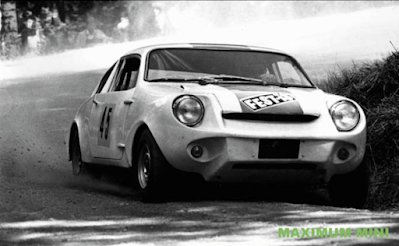

Börje Österberg in the Targa Florio Mini Marcos at Röforslopet hill climb on August 6th, 1968
where he came first in class. Note the repainted front after the Targa Florio accident  
Picture Lars Liifw via Per Haegermark

Now in France, this is confirmed to be the Targa Florio car wearing chassis number 7034
Picture Leboncoin

Börje Österberg was a Swedish ice racing champion in Minis. He is wearing the helmet here
Picture www.gelin.se/hakan-och-bilar

Elmhorn Troberg of Stockholm became the official Mini Marcos concessionaire in Sweden, 
but Andreasson's Targa Florio car had been an earlier import
Picture Jeroen Booij

They came up with this lovely brochure to attract Swedish Mini Marcos customers 
Picture Jeroen Booij archive

Ring Knutsdorp was the first race in which Andreasson entered the Mini Marcos
Picture progcovers.com

A week later Skarpnäck was the second. The Mini Marcos did not finish in both races
Picture progcovers.com

Thursday, 23 March 2023

The Targa Florio Mini Marcos (3)

If you have managed to read though part 1 here and part 2 here of this intriguing story about the Mini Marcos that made it to the 1967 Targa Florio race, you may like this part 3 too. Take a deep breath!

As we found out earlier Swedish racer Jan-Erik Andreasson, who entered his Mini Marcos in the 1967 Targa Florio, owned two Mini Marcoses in 1967. They were both built in the workshop of Ragge Håkansson in Köping, the one used on the Sicilian road race was the first to be finished with a 1299cc engine with twin-choke Weber carburetor good for 130hp and a Jack Knight five-speed gearbox, an integrated roll-over bar plus a low weight due to 'a lack of interior trim, soundproofing, Perspex glass in all windows except the front screen.' The second car was built later. Quoting again from the Bilsport article, which was published in November 1967 - six months after the Targa Florio race: "Of Andreasson's two cars, one is on wheels and has already been seen in the Swedish Championship races where it has competed against thoroughbreds like Porsche Carrera 6 and Lola T70. The other car is still just a shell resting outside Ragge Håkansson's workshop near the city of Köping, waiting for a new owner."

Question was which chassis numbers these two cars wore, and which of them was the Targa Florio car? Fact is one of the cars survives in Sweden and has been restored in more recent times: chassis number 7064, which does fit in with the dates. Interestingly, some pictures of it in its pre-restored condition were made by Richard Porter in 1995 and show it in white with a broad red stripe over its body. According to Swedish Marcos historian Per Haegermark that's correct: "As we all know the Targa Florio car was white with a green stripe and the sister car looked exactly the same but had a red stripe." That car wasn't built up as a racer though and being a slightly later car it has some different features also, among them details in the body's engine bay area.

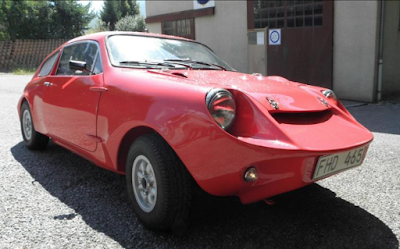
I must admit that the reason for this whole quest in finding out which the Targa Florio Marcos exactly is, was born out of an advertisement of a car offered for sale near Lille in northern France recently. This car wears chassis number 7034 and the Swedish registration 'FHD 465'. Translated from the French ad: "Put on the road in October 1967, after having had a first life in competition in Sweden as well as a participation in the 1967 Targa Florio, with racing number 176, before being registered. A justifiable history that needs to be studied in greater depth". I have to admit that I was skeptical at first when I contacted the current owner James. He wrote to me: "Thank you for your interest. I send you some evidence of his past life.". What followed in the next few weeks was a most interesting exchange of e-mails which got deeper and deeper into the subject. It must be said that James had taken the whole thing seriously and tried to turn every stone in his quest for proof. He'd contacted the FIA, the Targa Florio organization, the registration offices and several clubs and specialists, some with success, some not so, but he sent me copies of all this correspondence. He also added: "The marks of the accessories have left traces on my car. I have a whole history of these previous Swedish registrations, although unfortunately the first ones are still missing. I do have addresses to deepen and complete this history but I do not have the health for it. The co-driver of the 1967 Targa Florio (Johnny Lundberger-JB) tried to cheat by passing off a car, not yet built at the time, for that of the race in Sicily. I remain at your disposal for further information." 

Although it seems to have wiped out its checquered past, this car, chassis number 7034, fits in just right with the dates also. And while being red in colour now and missing some of the original features on it, I got more and more convinced that James could very well be right. And Per Haegermark agreed. He wrote: "Hi Jeroen, Many thanks for getting in touch with me concerning the Mini-Marcos #7034. Yes, I can agree with you that it's kind of a mystery that the Targa Florio car has been hidden away for so long. I have suspected for may years that #7034 really was the TF car but it wasn't until I made some enquiries at the National Swedish Archives who keep records of the old style (pre-1973) automotive registration documents, that I managed to link the car to the car mentioned in the Bilsport article. At the same time, I also happened to find the sister car #7064 which was built by Ragge Håkansson at the same time."

Ad he continued: "The original registration document (a copy of which I was sent also by James-JB) shows that the petrol tank contains 75 litres and the engine output is 105 SAE bhp. The sister car #7064 had a petrol tank containing only 28 litres and the engine output was 90 DIN bhp. The TF car definitely needed the long range petrol tank. Before I can tell you with 100% certainty that #7034 is the TF car, I have to see one more document which I have ordered from the National Swedish Archives. They normally need three to four weeks to find the requested documents. Will get back to you a.s.a.p. One thing which I would like you to change in your article is that chassis #7034 is a Mk2 and not a Mk3 body shell. Apart from this, I think everything is correct. If there are any difficulties to understand what's written in the Swedish articles, please do not hesitate to contact me for translation aid. For your information, I'm attaching some photos of #7034 in various guises. Looking forward to hearing from you soon. Kind regards, Per"

So that's it for now. Let's await Per's answer before we finalize with a conclusion, but I'd say things look as good as can be for chassis number 7034. Let me finally ad the list of subsequent owners the car has had, as they may be recognized by readers here and lead to more. Apart from Jan-Erik Andreasson (unconfirmed) these are: Anders Lindahl, Lars-Göran Ridell, Ohlson Bilfirma, Hasse Nörgaard, Claes Grönbäck, Lennart Andersson, Morgan Karlsson and Patrik Kaufmann. Before receiving 'FHD 465' it wore the registration numbers 'L 55135' and 'OA 70785'.

And one final thing that struck me from another report was that the car maybe didn't even make it into eight kilometres of the Targa Florio race. Translated from Swedish I found the following: "The first of the ten 72 km laps was not long before one of the Swedes disappeared with a bang. It was 'Nenne' Andreasson, who after just eight corners put his Mini Marcos in a pole."...


First outing? Jan-Erik Andreasson racing at Knutsdorp on 30 April 1967
Picture Åke Wremp via Per Haegermark

Another early picture at a race in Röfors with Börje Österberg at the wheel
Picture Lars Liifw via Per Haegermark

The other Mini Marcos of Jan-Eric Andreasson before restoration: chassis number 7064 
with its then-owner Viktor Kärrkvist in 1995
Picture Richard Porter

This Mini Marcos, for sale in norther France, ticks all the boxes to be the Targa Florio car
Picture Lesanciennes.com

It comes on a Swedish registration plate FHD 465, issued in October 1967, which fits in also
Picture Lesanciennes.com

Targa car wasn't red originally but "marks of the accessories have left traces on it"
Picture Lesanciennes.com

The early style dashboard also fits in with the build date and the Targa Florio
Picture Lesanciennes.com

Tuesday, 7 March 2023

The Targa Florio Mini Marcos (2)

I wrote about the Targa Florio Mini Marcos recently (see here) and added that I do believe the car survives also. I still do, but finding out which of the Mini Marcoses with an early history in Sweden it is exactly, is no straightforward job. I'll try to explain my researches as simple as possible, but warn you that it's still full of side-steps and other details!

The article in the november 1967 issue of the Swedish magazine Bilsport is a great starting point for the search, as it describes the car in some detail. But it doesn't give away a chassis number and in fact mentions three Mini Marcoses being in Sweden at the time - two of these were owned by Jan-Erik Andreasson and his company Babea Racing while a third car was owned by Bo Elmhorn at the time, who ran Elmhorn-Troberg Racing Service of Stockholm (more here and here). That last car is in fact the easiest one to track down. It is chassis 7073, a car that is in the USA now (see it on the Mini Marcos Owners Club website here). So that leaves us with two. 

But now things get blurry. Remarkably, the Targa Florio car is generally believed to wear chassis number 7418, registered 'BSU 400' in Sweden. That car claims to have spent all of its life in Swedish racing circles and had been restored once in 1983 in Sweden before making it over to the UK in 2010 and be restored once again as a FIA Historic competition car (see here). However, this is a highly unlikely claim as the chassis number 7418 has to be that of a later shell. According to Joost van Diën, who knows his chassis numbers, this one is likely to have been built in late 1969 or even early 1970 and has all the features of a car of that age, too. So with the Targa Florio taking place in May 1967 it seems unlikely to be that. 

But what can be the reason for its claim then? Swedish Marcos Club man Per Haegermark provides the answer through a letter of which I have a copy. In it he writes: "This car (#7418 - ed) is definitely not the Targa Florio car. It was imported to Sweden in 1979 and registered as BSU 400 in Sweden on March 4th 1979. The person who imported the car was the co-driver at the Targa Florio. Johnny Lundberger. He formed a Mini-Marcos Historic Racing Team in the early 1980's together with two other Mini racing guys. I think it was easy for him to claim that this 'new' car was his old Targa Florio car. No one could argue about this then. Bearing in mind its higher chassis no. it is more likely it was built in 1969 or 1970 and definitely not in 1967 that's for sure. Regarding the requirement of the cars being road registered for Targa Florio in 1967, it seems that it was not mandatory, since there were no registration plates on it at the race."

So now it's the question which were / are the two cars owned by Jan-Erik Andreasson in 1967 and which of the two was or is the Targa Florio car. Look out for that in the next article.


1967 Targa Florio race saw a Swedish entered Mini Marcos run by Jan-Erik Andreasson
Picture Jeroen Booij archive

The Targa Florio Mini Marcos came with a number of distinctive features
Picture Jeroen Booij archive

The november '67 Bilsport article, which featured it tells about it in some detail
Picture Jeroen Booij archive

Babea Racing AB was Andreasson's company
Picture Jeroen Booij archive

Co-driver Johnny Lundberger in 1994. He died in 2009 but imported a Mini Marcos to Sweden in 1979
Picture Micke Pettersson / mpmoke.se

This car: 'BSU 400'. It is generally claimed to be the Targa Florio car but I don't think so 
Picture Platesmania.com

It has quite a comprehensive competition history also and is in the UK since 2010
Picture Jeroen Booij archive

Monday, 20 February 2023

The Targa Florio Mini Marcos (1)

Mini Marcoses have been entered in a number of great races, and the 1967 Targa Florio is certainly one of these. Although it didn't finish the tough Italian road race, it is about time to have a better look at this unlikely entry. The car was run in the scorching heath of Sicily by a team of two Mini drivers from the opposite part of Europe: mid-Sweden. Jan-Erik Andreasson had been racing a Morris Cooper 'S' locally there and internationally at the Nurburgring 6-hours race of 1966. His pal Johnny Lundberger raced Minis from 1964-on with some international events on the racing calendar also.

The Marcos was Andreasson's car and had been built in the workshop of Ragge Håkansson in Köping, some 150 kilometres west of Stockholm. As a matter of fact Andreasson had two Mini Marcoses, both of them Mk3 cars. The Targa Florio car was the first to be built and according to Bilsport magazine it was a pure racer, built with Group 6 racing in mind, with integrated roll-over bar, 1299cc engine with twin-choke Weber carburetor good for 130hp and a Jack Knight five-speed gearbox plus a low weight due to "A lack of interior trim, soundproofing, Perspex glass in all windows except the front screen."

By the time the Bilsport reporter drove it, it had come back from Sicily and he wrote: "Under the supervision of friendly local police officers, we could take out the car for a short test trip on a road stump in Köping's new oil harbour."

He also gives us more insight into the car's debut race at the Targa Florio and the reason for not finishing there: "In spite of its age, the car has a rather brutal past. The idea was, when the car was brought to Sweden, that Jan-Erik would compete with it abroad where a prototype class of up to 1300 cc was introduced. The race debut was at Sicily in the famous Targa Florio race. The car was then run by Jan-Erik himself with co-driver Jonny Lundberger. The practice went without any major problems if you ignored the fact that the car was slightly too low geared. During the night between practice and race, Ragge Håkansson changed the final drive and it was this maneuver that sharpened the Swedish participation. After eight kilometers into the race and with the worst competitor Rauno Aaltonen in sight, despite the fact that the Mini-Marcos started several seconds behind the Aaltonen A-H Sprite, Jan-Erik suddenly forgot that the car was now on a higher final drive gearing and entered a corner at a speed corresponding to the lower gearing. At max. speed, the difference between the two gearings was 30 km/h i.e. 30 km higher speed in a corner where it already was close to the limit, is no doubt too much. You can easily imagine the outcome of this yourself."

And so... after only eight kilometers on the hot tarmac, the race ends for Andreasson and Lundberger. But back home in Köping the car is rebuilt and handed over to the Bilsport reporter, who adds: "The driving position is perfect. The seat makes it easy to handle the pedals without holding you tightly with your knees. Initially we had problems with the gear change reverse positions. First gear is to the far left and forwards, second in the normal position of the second, third is where first gear normally is etc. Ragge Håkansson gave order not to exceed 9000 rpm."

That's quite an order, which makes you wonder if the Marcos survived that! The good news that I believe it does, to this day even. So more about that in the next volume.


Two Swedish chaps on a hot Sicily with their Mini Marcos racer
Picture Gioacchino Guilotti

Jan-Erik Andreasson
Picture IMMS vintage photos

Johnny Lundberger
Picture Bilsport magazine

And the Marcos, built to Group 6 specifications by Ragge Håkansson
Picture Vittorio Giordano

It used a 1299cc engine with twin-choke Weber and Jack Knight five-speed gearbox
Picture Vittorio Giordano

On the start grid at the Targa Florio, Rauno Aaltonen's Sprite in front of it
Picture Gioacchino Guilotti

And off it goes, Andreasson behind the wheel, 130hp to run in on Aaltonen
Picture Jeroen Booij archive

But there had been an issue with the car's gearing...
Picture Rainer Schlegelmilch

...And so the final drive was changed overnight
Picture Geoff Goddard

It was to meet its fate after only eight kilometers on Sicily's hot tarmac
Picture Eric della Faille

This is supposedly Jan-Erik Andreasson walking away from the car after its accident
Picture source unknown

But the Marcos came back to Sweden, rebuilt and ready for another test drive here
Picture Motor Sport magazine

Monday, 31 October 2022

Swedish Marcos to be auctioned

A lovely Mk3 Mini Marcos that was supposedly sold new to Sweden is now offered for sale in an auction. The car is said to have been sold through Swedish concessionaire Elmhorn-Troberg Racing Service and was first registered in Sweden in 1969 with a Mk1 Cooper from Kalmar used as a base vehicle to build it up. 

It does remind me of Bo Elmberg's Mk3 that could be seen racing a big Ferrari in anger on the Roskildering in 1967 (see here). Remarkably, Mini Marcoses were built in Sweden also and it could perhaps even be one of a few made there, too. Click here for the full story about that. 

Fact is that it's seen some modifications over the years, including a straight cut Cooper 'S' gearbox and many more tuning parts. The wheels are rare Swedish-made JP alloys, very period. Inside an Innocenti dashboard has been added but most of the interior is believed to be original. The car was bought by the current owner in 2017 who is now selling it due to other restoration projects. For the full description from Bilweb Auctioneers click here. Bidding starts on the 3rd of this month and the estimate is 170- to 190,000 Swedish Crones (12,600 - 13,400 GBP or 14,500 to 15,500 Euros approx.).


A Swedish Mini Marcos Mk3 of 1969 is offered for sale in auction
Picture Bilweb Auctioneers

A nice and clean car that was supposedly sold new to Sweden
Picture Bilweb Auctioneers

Swedish concessionaire was Elmhorn-Troberg Racing Service of Stockholm
Picture Bilweb Auctioneers

Built originally with a Mk1 Cooper as a base it has been modified heavily
Picture Bilweb Auctioneers

The interior is said to be largely original though. Dashboard is a later Innocenti
Picture Bilweb Auctioneers

Lovely lightweight wheels are rare JPs (not JAPs), also made in Sweden
Picture Bilweb Auctioneers

Monday, 8 February 2021

Swedish road test of Broadspeed GT shows FOH 500D again

About half a year ago I wrote about a Broadspeed GT registered FOH 500D, which was road tested by Motor in 1966 (see the article here). Thanks to some observant readers I learned that the same car was road tested in period by a Swedish magazine named Bilsport also. A Swedish website showed a copy for sale and Rainier de Klark, who runs Klark Classic Cars in Sweden was kind enough to buy it for me and send it over. I've copied the report and its pictures below - all for you, dear reader! 

Like Motor magazine, Bilsport's road tester Per Cewrien also mentions that the 1275 engine produced around 100hp. He made it over to Birmingham to drive the car and photograph it for a two-page report in May 1966. His article is mostly about Broadspeed itself, the technical details of the car and how it was built. But Cewrien concludes the article with a remarkable ending. He writes: 

"Som de flesta kanske förstår, ar Broadspeed GT en bil, som vem det vara månde bör kunna komma överens met och vi ser onikligen fram mot den dag då den kommer att importeras till Sverige. Vissa trevare har gjorts i den vägen, men mer är det väl inte." Google makes the following of that: "As most people may understand, the Broadspeed GT is a car that anyone should be able to agree on, and we are unequivocally looking forward to the day when it will be imported to Sweden. Some threesomes have been made in that way, but it is probably no more." What did he mean there? Was this only the third car made and did Ralph Broad really plan to stop production already at the time? That would rewrite Broadspeed history, wouldn't it?


UPDATE 17:30: No rewriting needed. Micke Pettersson helps us out of the dream.: "A quick translation: ... we certainly look forward to the day when it will be imported to Sweden. Some careful attempts has been done in that way, but more is it not" Interesting, though!


Swedish road tester Per Cewrien had a go in the Broadspeed GT, probably in early spring 1966
Picture Jeroen Booij archive

This picture of FOH 500D was seen before on Maximum Mini. It must be from the same shoot
Picture Jeroen Booij archive

Better view on the picture in Per Cewrien's report, clearly made at the same place
Picture Jeroen Booij archive / Bilsport magazine

Did Bilsport magazine really write that only three Broadspeed GTs were made in 
May '66 with no more to follow?
Picture Jeroen Booij archive / Bilsport magazine

From the original article: "The steering wheel has significantly more rake. The front part of the door compartment houses a combined compartment for cigarettes and other small items"
Picture Jeroen Booij archive / Bilsport magazine

 From the original article: "The engine is said to have been machined outside and inside"
Picture Jeroen Booij archive / Bilsport magazine