Monday, 2 January 2017

Another Cox GTM to be resurrected

In one of the last days of 2016, Mk1 Mini Marcos owner Peter Skitt dropped me a line. Peter is a professional classic car and bike restorer based in West Yorkshire, see here, who beautifully resurrected his early Marcos. Surprisingly, his message was not just about the Marcos this time, but about his latest project: a Cox GTM! It certainly looks to be another unspoiled car to me, and it seems Peter is giving it the attention it needed. He added: "The plan is to be at Blyton next year, driving the Marcos with the Cox GTM on a trailer at the stage it’s at, at that time, should be interesting!"
That's an understatement if you ask me. Oh - and Peter's GTM won't be the only example of the breed at Blyton, as the plan is to celebrate the Cox GTM's 50th anniversary there. Despite having been so busy with my Marcos I haven't had the time to get to this, but I soon will (sorry Stuart!). More to follow.

Early Cox GTM does perhaps remind of John Fisher's car, found in 2013? 
Picture Peter Skitt

Unlike many others, all the right features are there to identify it as a Cox
Picture Peter Skitt
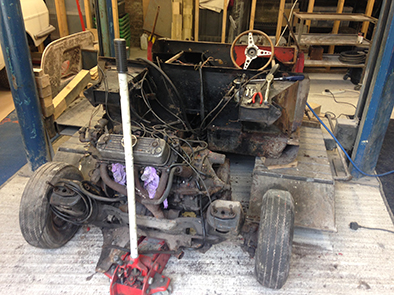
And Peter is not taking half measures to restore the car. Body and subframes taken off here…
Picture Peter Skitt

The car's semi-monocoque steel chassis looks solid in all its bareness…
Picture Peter Skitt

…But Peter has taken the welding torch to get rid of any possible rot
Picture Peter Skitt

That looks like a brand new tub. A great way to start building it up again as a GTM
Picture Peter Skitt

The car's engine is a rare Nerus tuned example. Peter is restoring that now, too 
Picture Peter Skitt

Body is almost ready for the painter again. You may see it at Blyton this year
Picture Peter Skitt

Sunday, 1 January 2017

Happy 2017! Winners announced

Maximum Mini Find of the Year 2016: the 1966 Le Mans Mini Marcos
Picture Jeroen Booij

I have to admit that it's no big surprise that the Mini Marcos Le Mans car won the title of Best Find of 2016 with 89% of the votes. As you will know the car is owned by your's truly and I will keep you updated on the project of bringing it back to its former glory: that of the Summer of 1966, when it was famously raced at the circuit de la Sarthe. In the meantime, I have been totally overwhelmed with reactions, some of them leading to more information about the car's checkered history or even to parts that were fitted to it originally. Thanks also for voting, not in the last place to the brave people who chose for one of the other four cars that made it to this year's poll.

And then there was the traditional Maximum Mini Christmas puzzle. Won once again by Neil Kilbane. Congratulations, Neil, a book is on its way. Just let me know what I can sell to you as you are costing me far too much! The right answers were:

1. Peter Hanman, Cadwell Park, 1975
2. Hans Casteleyn (Algemeen Racing Team), Zandvoort, 1969
3. William Dulles, Nürburgring 500 kms race, 1966
4. John d Green, Brands Hatch, 1966
5. Geoff Mabbs, Weston Super Mare Speed Trials, 1965
6. Claude Swietlick and Johnny Rives, Paris 1000 kms, 1966
7. Adam Potocki and Claude Swietlick, Paris 1000 kms, 1966
8. S. Hemley, Silverstone, 1965
9. Jean-Louis Marnat and Jean-Pierre Jabouille, Paris 1000kms 1966
10. António Batista, Vila Real, 1981
11. Tim Lalonde, Le Mans test day, 1967
12. Jackie Bond-Smith and Joey Cook (FLIRT), Nürburgring 1,000 kms, 1967
13. Guy Edwards and Peter Anslow, Nürburgring 1,000 kms, 1967
14. Andreasson / Lundberger (Babea Racing), Targa Florio, 1967
15. Roy Johnson and Guy Edwards, Gran Premio del Mugello, 1966
16. Andy Barton, Rufforth Airfield, 1967

Sunday, 25 December 2016

Christmas puzzle 2016

Since 2010 you can find the traditional Christmas puzzle here, so this is the 7th. With the Le Mans Mini Marcos still in my mind, this year's theme is... racing Mini Marcoses! Below you can see a selection of 16 such cars and what you need to find out is the venue they raced, and preferably also the year, with all extra information such as drivers and qualification as bonus material. There is a tie break question below in case more then one competitor come up with the right answers. The first who has them all right wins a copy of Maximum Mini 3, the new book that came out earlier this year. And I'll sign it for you and give it a little extra designation! Send your answers via the comments below up until December 31 of this year. Good luck!


Saturday, 24 December 2016

Have a merry Christmas

Tomorrow you'll find the traditional Christmas puzzle on this page, but for now I already wish you a merry Christmas and a happy New Year with lots of Mini (based) motoring to all readers of this blog and all other Maximum Mini fans. Thank you for your support in 2016 and don't forget to vote for the 'Best Find of 2016'!

One of several cartoons from Skyspeed brochure, showing their Mini based Siva Buggy
Image Jeroen Booij archive

Tuesday, 20 December 2016

Analyzing the Le Mans Mini Marcos (3)

Unfortunately, just about all of the mechanicals of the Le Mans Mini Marcos have disappeared, but there are still some signature marks that have been saved. The fuel tank, the pedal box and the pick-up points where the roll bar was attached to the car's body shell. Let's have a look at them.

This is the fuel tank in its position. Hrubon said he made it himself and it could carry 80 litres of petrol
Picture Jeroen Booij

And this is what it looks like when you take it out. The base definitely is from a Mini Van, but the top?
Picture Jeroen Booij
The filler opening is huge, 120 millimeters in diameter - I can easily put my wrist in it
Inside it has wash plates to keep the fuel in balance in corners
Picture Jeroen Booij

The same tank is good visible in this shot, taken of the car in the Le Mans pit lane in '66
Picture Jeroen Booij archive

And again, on the same spot in that memorable summer of 1966
Picture Jeroen Booij archive

This detail shows the thing even better. The photograph was taken in 1975 when the car had been painted maroon and road registered. Note that the exhaust pipe is now relocated to the rear of the car. It had a side pipe at Le Mans. Roll bar also good visible
Picture courtesy Michel Tasset / Jeroen Booij archive

Here you see the tank again, plus the cut out left overs of the roll bar on the floor, where it was moulded into the fibreglass. The diameter of the frame is 35 millimeters. Not today's standard!
Picture Jeroen Booij

Detail shot of one of the four cut pout points in the fiberglass. I guess this was a factory option, 
so there have to be more Mini Marcoses with a similar cage. More info is welcome
Picture Jeroen Booij

The roll bar is very good visible here thanks to the white background of the Dunlop sign behind
Picture Jeroen Booij archive

And that's the adjustable pedal box! Clearly home-made and very simple, but it may well have
 been effective. Perhaps due to the size difference of the two drivers Ballot-Lena and Marnat?
Picture Jeroen Booij archive

Friday, 16 December 2016

Jean-Claude Hrubon dies at 78

It is with great regret that I announce the death of Jean-Claude Hrubon, who passed away on the 18th of November, not long before his 79th birthday. Jean-Claude was the main force behind the Le Mans entry of the Mini Marcos in 1966, but also came up with the Mini-based Hrubon Phaeton plus several more cars. He just finished his biography (review here) and was still full of plans, but unfortunately had no more time to effectuate these. It is extra bitter that I just found back his beloved Mini Marcos days before his passing. I'm sure he would have loved it. 

When I interviewed him in the summer of 2013, my last question was wether he had any motoring related dreams yet to be fulfilled? “No”, was his immediate answer. "That’s finished now. I’ve had an extraordinary life. I happened to be at the right places at the right times in the 1960s where people in racing formed a friendly bunch. I would do it again, no doubt. The only dream left now is to die peacefully.”

Hrubon in his garage in downtown Paris in the mid-1960s, always working on Minis
Picture Jeroen Booij archive

Behind the Mini Marcos at Le Mans in 1966. You know what happened to the car now
Picture Jeroen Booij archive

With his son Laurent in the Hrubon Phaeton prototype in the early 1980s
Picture Jeroen Booij archive

With his daily driver in summer 2013. Hrubon was a lovely man, full of anecdotes
Picture Jeroen Booij

Wednesday, 14 December 2016

What is going to be the Find of the Year 2016?

I nearly forgot a grand Maximum Mini tradition: the official 'Find of the Year' poll! Several interesting Mini based cars were found in sheds, lock-ups, gardens and garages again and I made a selection out of 5 of them.

You will find the cars that have made it to the contest below. To vote simply go to the poll on the right side of this blog (click here if you read this through an email message) where you tick the box of your favourite find. The one with the most votes wins - it's simple as that. Now, over to the candidates.

1. The Stimson Safari Six

Found in Rochdale by super-Stimson-fan Paul Wylde after a long search. 
Paul is working avidly on the restoration now, so work in progress

2. Magic Alex' coachbuilt Mini

A coachbuilt Mini formerly owned by Beatle-technician Magic Alex that is shrouded in mystery. 
Was it a Wood & Pickett job, or not? Fact is it survives.

3. The Sabre Vario demonstrator

A Sabre Sprint is rare, but a Sabre Vario is even much rarer! The factory demonstrator turned 
up for sale in Newcastle - still with the company which built it!

4. The Le Mans Mini Marcos

What can I say? My own reward after a painstakingly long and chancy search. 
The legendary Le Mans Mini Marcos is back from the brink
Story here, here and here (and more to follow!)

5. The Sandringham Six Mini

A reader wondered about the whereabouts of the Sandringham Six Mini, and its story was 
unraveled here. Only to see the car being advertised for sale a month later!
Full story here, here and here


Tuesday, 13 December 2016

Analyzing the Le Mans Mini Marcos (2)

Identifying a car can be easy when you have enough historical photographs. I found quite a lot of holes on the car I recently bought, and all of them can be traced back to its past, wether they have been filled or not. It was the major key to identifying the car as the Le Mans Mini Marcos.

Holes for the side indicators were a giveaway on the Le Mans Mini Marcos. 
But what's that little hole just in front of it?
Picture Jeroen Booij

This is the signature indicator like it should be, seen here at the Le Mans weigh bridge
Picture Jeroen Booij archive

But here we see the car again in 1970 at the start of the Treffort hill climb with the added hole. 
I have no idea what this was for. Also note the modified bonnet, just like it is today
Picture via Enguerrand Lecesne

Holes were drilled in both doors to illuminate the door numbers during the night section
They have all been filled but cannot be rubbed out completely
Picture Jeroen Booij

The same door can be seen here with the lights still in it
Picture Jeroen Booij archive

And also from the inside it's clear that it used to have holes here. The doors appear never 
to have had side boxes like most other early Mini Marcoses have
Picture Jeroen Booij

This is just to show the left hand side had similar lights fitted to illuminate the number 50
Picture Jeroen Booij archive

This is the modified bonnet of the car. You can still see the holes were the little bulges 
were made to make the 1 1/2" SU carburetors fit properly
Picture Jeroen Booij

These bulges can be seen here, this picture was taken at Le Mans test day, 
they were painted during the actual 24 hours race
Picture Jeroen Booij archive

The rear lights used came from a Simca 1000 and these should still fit in perfectly today
Picture Jeroen Booij

There they are as shown at the Le Mans pit street back in 1966
Picture Jeroen Booij archive 

The big filler gap, now filled, was of course another great giveaway clou in identifying the car
Picture Jeroen Booij

Seen here with the now missing, and rather huge, filler cap. The tank is still there 
Picture Jeroen Booij archive

This was another clue. The car originally had one of the fake louvres on the left hand side 
opened up. It's still the same after all these years
Picture Jeroen Booij

Here again from the same angle, but now taken in 1966. The opened louvre is good visible
Picture Jeroen Booij archive
Not much of the interior is left, but the dashboard still shows plenty of recognition marks
There are three holes on top, right of the centre, plus one on each side on the left 
Picture Jeroen Booij

This is the only good historical photograph I have of the car's interior, taken in 1975
You can clearly see all the holes that are still there. Also note two holes in left hand door
Picture Michel Tasset / Jeroen Booij archive

The car used just a single wiper on the left hand side as it was left hand driven
Picture Jeroen Booij

Initially a wiper could have been fitted on the right, too, but this hole was later filled
Picture Jeroen Booij archive

Monday, 12 December 2016

Analyzing the Le Mans Mini Marcos (1)

Over the next few days or weeks, I'll update you on the discovery of the Le Mans Mini Marcos. Looking back I can tell you that identifying it as the real deal wasn't the easiest of tasks. I received three sketchy pictures of the shell and had to work from there. Now that I have it, things are much easier. Take the layers of paint, for example. These can best be described with the list of previous owners that my friend and colleague Enguerrand Lecesne made.

1966-67: Hubert Giraud and Jean-Claude Hrubon, (Paris) 24h Le Mans 1966, 1000 km Paris 1966-67.
1968 Alain Asse (Boulogne-Billancourt near Paris) Hillclimbs, races
1969 Aiguebonne (south of France) registered, painted Green, rally in south of France
1970 José Albertini (Nice), painted orange, Monte Carlo Junior rally. During that period: modified bonnet, new Delta Mic wheels, lights for rallying...
1970 Jean-Louis Grappin (Neuilly near Paris) Hillclimb (Treffort), engine broken, car left off.
1973 Dominique Mercier (Essonne), painted Maroon, 998 engine.
1975 Michel Tasset (Eure et Loir)

I now found out that the car was repainted in a lighter blue with an orange stripe to match Hrubon's later 1967 Le Mans entry (a Renault Gordini powered sports car of his own design). There is photographical evidence of that, too, with the two cars standing next to each other at Hrubon's garage, so it does fit in. I also think that it was not painted orange in 1970 but a light red instead, as this is the colour that comes next after the green. Also: after it was lost in October 1975 it appears to have been painted twice more, both times a shade of red, too.

So in the right order that's:

French Blue with yellow stripe
Light Blue with orange stripe
Dark Green
Red
Maroon with yellow stripe
Red
Red

Now, have a look at these photographs, to make it all fit

This is the front center of the roof. The French blue and yellow stripe are clearly visible. After that it's light blue, green, red, maroon (with a new slightly darker yellow stripe good visible, too) and two more layers of red
Picture Jeroen Booij 

Same spot just above the windscreen, but now from the other side. Here, you can also see the orange that was used for the stripe
Picture Jeroen Booij 

This is the right hand front wing. No yellows are visible here as these were only painted in a broad stripe over the length of the car. French blue is just visible under the light blue paint
Picture Jeroen Booij 

The original French blue can be found everywhere as the first paint colour
Picture Jeroen Booij 

This is the right hand rear wheel arch. What I like is that the white roundel is still hidden here, too
Picture Jeroen Booij

This is even more closed up onto the wheel arch. Unfortunately these have been modified, with the arch smoothed onto the body. The filling material can be clearly seen here
Picture Jeroen Booij


UPDATE 13 december 2016: 

Enguerrand Lecesne writes to me:

Speaking about colours:

1966 French blue was an idea of Jean-Louis Marnat to do Le Mans
1967 light blue (bleu ciel) with orange stripes, in 67, Claude Plisson explains that it was an idea of Hrubon: give a repaint in Gulf lookalike colors (Mirage cars)...
1970 Albertini, the color was certainly Red (Albertini dixit) but it is vermillon, a red with orange (this is what i've called orange to give you a clue).

Thank you!