Tuesday, 7 September 2021

Is Sue's Grantura Yak really a 1967 car?

Sue Willis wrote to me about her newly purchased Grantura Yak: "Hello Jeroen I am a new subscriber to your blog and wonder if you can give me any help with my new purchase of a Grantura Plastics Ventura Yak. I purchased it from a friend who is 92 and hasn't driven it for some years but it's a runner and I intend to spend the winter sorting it out properly. He needed the garage space for his mobility scooter and I happened to be in the right place at the right time!"

"There doesn't seem to be much information on the internet and it has a Q registration meaning 'indeterminate age' (as I'm sure you know). The log book gives it a date of 1988. However the chassis number is GP/YAK/011/67 - does this mean it was built in 1967? Looking forward to hearing from you. Kind regards Sue".

I had to dig into the magazine archive as the original press release that I have of the Yak is unfortunately undated. But I found that the first appearances of the car in the motoring press date back to October 1969 (The Autocar, Hot Car plus Car & Car Conversions), so I think it's safe to say the first production Yaks appeared in late 1969. So... what does that make of Sue's car? Anyone who has an idea, let me know!


Sue took over this Grantura Plastics Yak from its former 92 year old owner
Picture courtesy Sue Willis

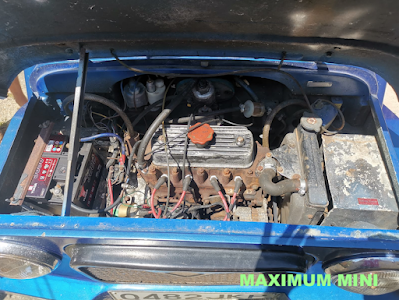
"It's a runner and I intend to spend the winter sorting it out properly"
Picture courtesy Sue Willis

The chassis number seems to indicate it was a '67 build. But is that even possible?
Picture courtesy Sue Willis

The Grantura Yak is not mentioned in the motoring press before late-1969
Picture Jeroen Booij archive

Monday, 6 September 2021

GTM news flash

There is some great news about Cox GTMs and a Heerey GTM that I thought would combine nicely in a little news flash here. 

First of all, the '67 Cox that I found in April (this one) was finally picked up by its new owner: Trevor Powell. Trevor is a much respected Mini man, who you may remember from this article about the cars built by his dad Bill Powell. Trevor told me he always fancied an early GTM and didn't hesitate when this one came along. The plan is now to turn the car into a sprint / hill climb machine but Trevor is not in a rush as he's got some exiting other projects first. He asked me if I could bring it over to Calais, which I did. I met him and his wife Melanie at a parking place close to the motor way there where we swapped the car over from one trailer to the other. They drove back home to the UK that same night and the next day he wrote: "We finally got home at 4.45am with no issues at customs etc. Very happy with the car and all the parts!" I'm very happy with that, too.

Elsewhere in the UK, Nick Wilkins, who owns the ex-Cars & Car Conversions Cox GTM racer, found another car. He wrote: "I must be mad as have just brought another GTM. This one is was on a farm clearance. All I know about it is what I could see in the pictures. Hope to collect it next week. Think you call this a barn yard find!" Certainly looks like it mate, well done to you!

Last but not least an exiting and brand new build was seen at the Stoneleigh kit car show at the stand of Hambly Sportscars Ltd., manufacturer of the Hambly Coupe (more here). I think that is a fantastic looking car and eagle eyed readers will have recognized it straight away as 'The Green Machine' (this one) in a new guise. I hope to meet up with Derek and the car in person soon.


Thursday evening, on a parking place in Calais. That's Trevor and Melanie Powell. The Cox has just moved from my trailer to Trevor's and the car is now back in the UK
Picture Jeroen Booij

Trevor owns some great historic racing Minis, but had been looking for a Cox GTM for ages: "I've always wanted one!" he told me. It will be built into a sprint car / hill climber
Picture Melanie Powell

Meanwhile, Nick Wilkins, who owns the ex-Car and Car Conversions Cox GTM found this Heerey GTM in a farm clearance and picked it up
Picture courtesy Nick Wilkins

This one is a Heerey GTM 1-3 of around 1970 and it has been on the road before says Nick. 
Currently there is no registration though
Picture courtesy Nick Wilkins

Last but not least this fantastic car was on display at the Hambly Sportscars stand at the Stoneleigh kit car show. You may recognize it as 'The Green Machine'
Picture courtesy Ferg Ranson

Wednesday, 1 September 2021

Beach car enjoyed to the max

I noticed it had been seven years since an Austin Beach Car was sold for record money (full story here) and wondered what happened to it since. I dropped the owner, who wished to remain anonymous, a line and got a swift and enthusiastic reply: "Jeroen, we still love the car! It is at our club where we use it a lot. Nearly every day. The club is not very big so it does not go far, but once we took it to a restaurant about 20km away. People love the car everywhere it goes. Many smiles and waves. Thank you for checking in."

It's good to hear that the car is enjoyed. Thank you! About two years ago another Austin Mini Beach Car was auctioned in the USA (click here) and that even shattered this car's record price. 


The Beach Car that was sold in Monterey in 2014 is enjoyed nearly every day
Picture Jeroen Booij archive

Tuesday, 31 August 2021

Hubert Giraud passes away

It is with great regret that I heard of the passing of Hubert Giraud on July 19 after being contacted by his son Alexandre yesterday.

Giraud was the last of the original team members who raced the Mini Marcos car at Le Mans in 1966. The two original drivers (Jean-Louis Marnat & Claude Ballot-Lena) both passed away many years ago, while the man who’d originally built the car, Jean-Claude Hrubon, had sadly died just days before me securing the deal on the car. His first mechanic, Claude Plisson, had also followed after I had just tracked him down...

That made Giraud the last man to find, and again it took time, but fortunately I did visit him and his wife Christine in their beautiful house on the outskirts of Paris a few years ago. Giraud had not only been the team's boss, he was also the man who'd sacrificed his Morris Cooper ‘S’ to have the Marcos built and the man who paid for all the expenses! 

He was 81 when we met in December 2018 and his memories about the events were crystal clear. He'd also kept records in little notebooks writing out all his expenses for every year. We found both the Cooper 'S' base vehicle as the Mini Marcos shell back in them easily enough. Giraud even had the original Marcos brochure with prices scribbled in French francs on it. Next came out a map with documentation, pictures and letters. Some of these were from Marcos boss Jem Marsh, who wanted to have the car on display at the 1967 Racing car Show. With Giraud speaking hardly any English and Marsh hardly speaking any French, communication between the two men proved a challenge, but it worked out well thanks to Marsh' secretary - Miss SM Davis - who spoke French. She wrote these letters with Marsh simply signing them off and the car made it to the show (I'm still looking for more photographs). Monsieur Giraud allowed me to copy all of the correspondence, including a hand written list of all the other people involved at the Le Mans project. His brother was one of the ‘chronos’ and they had some people standing along several corners of the track to keep on eye on the little car. 

Last but not least he told me they had overalls made with Mini Marcos patches sewed on them. I’d seen these on a few historical photographs and had thought of remaking these also, but now he showed me two of the original spare patches, one that was handed over to me. It was a truly wonderful meeting.

With Hubert Giraud's death a chapter in the Mini Marcos' rich racing history has ended. I wish his wife and children all the best. Repose en paix a un grand monsieur.


Giraud with a model of the 1966 Le Mans Mini Marcos. He was the team boss and backer
Picture Jeroen Booij

Giraud in 1967 with his brother Bernard and the two Le Mans cars built by Hrubon: the 1966 Mini Marcos and the 1967 Hrubon Thélème on the right. The Marcos was repainted at this stage to match the Hrubon
Picture Jeroen Booij archive

A letter from Marcos Cars to confirm the Marcos' appearance at the '67 Racing Car Show
Picture Jeroen Booij archive


Hubert Giraud (right) with his wife Christine and myself just outside Paris in December 2018
Picture Jeroen Booij archive
Monday, 30 August 2021

An ABC Tricar in France

Another ABC Tricar has resurfaced, this time in Cazouls-lès-Béziers, southern France, which makes it the second that I've heard of outside of the UK. The car comes with a massive Roadhog front spoiler and is offered for sale in one very curious ad. The seller writes:

"ABC manufactured 17 to 24 (3 first partially steel prototypes, 4 with Clubman style nose and 17 full fiberglass bodied cars) Minis with three wheels." I have no idea where that information comes from and I'd love to be educated here but as far as I know there was just one steel prototype (more about that here and here).

But let's not get carried away and continue with what the seller writes:
"I have the French CG (carte grise - the French registration paper) in my name. I never intended to sell it (there is restoration work on it) but I could well use the money for a real estate project. I don't have a lot of photos because I prefer people to come and see for themselves. The price (or close offer), is of course given its rarity and originality (and because it's more durable than a Mini given the fiberglass body). All enthusiasts know that the older the Mini, the more rust, the higher the price... this will not be the case here." Again, I'm not so sure about that and can only ad that the 15,500 euros asking price seems rather steep!

And he goes on: "Do not contact me hoping for a new vehicle, if ever this is the case with a Mini? It's the paperwork that's worth the money, not so much the restoration, which is not expensive for an enthusiast who does not count his hours, but very little in relation to its rarity and the fact that it is beautiful and correctly registered in France. As such it is not a kit car (impossible to register a foreign kit car for years, otherwise I would have had a bunch!), but a brand / an officially recognized manufacturer. An obscure tricycle is not necessarily worth much even if it is super rare, but here it is the fabulous Mini, one of the most popular cars of all time. It took me 6 years to find one (found it 5 years ago) and none have appeared for sale since. I was planning to put a classic front (and get rid of the wide kit) and paint it in a pearly white with gold accents and rent it out for weddings for Mini fans."

How about that? It's good to see it never the less and I have now also added it to the list of ABC Tricars that I know of (here). Thanks all for the tips.


A modified ABC Tricar is seen here in southern France. And it's for sale, too
Picture Leboncoin

Friday, 27 August 2021

Bulanti straight from the moulds

A rare picture taken in Annangrove, Australia in 1971, where Brian Rawlings built his Bulanti at the time. Rawlings' workshop Bulant Motors was located next to Amaroo Park raceway in New South Wales so track testing wasn’t too much of a hassle. 

Apart from the aluminium prototype only two more production cars were made with fibreglass bodies and I think the one seen here has to be one of these. Is the white car on the second pictures the same? The last picture was sent to me some years ago and I don't know its source, so do let me know if it's yours. More Bulanti articles can be found here. 


A rare Bulanti is made in Annangrove, Australia in 1971
Picture Mark A McGuire / Aussie Independant Car Community

Same car or another? Just three Bulantis were made 
Picture Jeroen Booij archive

Thursday, 26 August 2021

Crayford Cameo: any survivors?

Crayford Engineering of Kent were the number one in Mini convertible conversions, building them from as early as 1961 up until as late as 1983. They turned a number of Mini Clubman's in convertibles in the early 1970s also, which they called the Crayford Cameo. From their press statement: 

"The Cameo is the latest convertible variant based on the Mini theme. It is the result of many years of development and production by Crayford and utilises the very latest chassis installation to ensure maximum torsional rigidity. The rear windows remain in place in their original form with opening clasp permitting full ventilation as on the original saloon, and the convertible top folds down in one easy action." The conversion alone came at 195 pounds.

I have some PR pictures of the car but have never seen one in the flesh. Are there any survivors at all?


The Crayford Cameo convertible was based on a 1970s Mini Clubman
Picture Jeroen Booij archive

A black hood was standard but all the cars I have pictures of have white ones, like this FHV 167J
Picture Jeroen Booij archive

The same car again, now with Crayford boss David MacMullan posing in 1971
Picture Crayford Convertible Car Club

And yet another, judging by the colour. But who ever saw a survivor of the Cameo?
Picture Jeroen Booij archive

Friday, 20 August 2021

Making the Mini Shark (2)

Yesterday you could see pictures showing the building process of the one-off Mini Shark, designed and built by Terry Lee between 1969 and 1974 (here), today some more information on that car.

Lee made the body design in carton board but chose fibreglass to make the real thing. That was something he regretted afterwards, or so he told me: "It was an awful lot of work and the insurance didn’t like it”. It's also the reason why the later Mini Beavers that he built came with steel bodies. 
But with its yellow paint, square headlights and a sharply chopped-off tail with Mk1 Escort lights and painted in contrasting satin black the finished Mini Shark did look rather nice.

Once Lee had it on the road the Mini Shark was tested and received a brand new registration in 1974: 'OWT 694M'. Lee used it for several years before he sold it and he told me he believed the car no longer exists when I visited him in Leeds some 10 years ago. However, a picture of it did appear in the 1990s, when the car was supposedly found in Glasgow, Scotland, in a stripped state. Could it still survive? Who knows more about it? 


Once finished Mrs. Lee naturally had to pose with the car her husband designed and built
Picture Terry Lee / Jeroen Booij archive

The Mini Shark's body was made of fibreglass - something mister Lee regretted afterwards
Picture Terry Lee / Jeroen Booij archive

OWT 694M - the only Mini Shark - is seen here together with a Mini Beaver, also built by Lee
Picture Terry Lee / Jeroen Booij archive

The car's Mini engine was a 1000 sourced from a Mini Van and placed at the rear
Picture Terry Lee / Jeroen Booij archive

Flip back and flip front. Behind the latter the petrol tank and battery hid
Picture Terry Lee / Jeroen Booij archive

Interior with lots and lots of switches, gauges and lights. Note Shark logo on wheel, too
Picture Terry Lee / Jeroen Booij archive

Terry Lee 10 years ago in August 2011, when I interviewed him about the Mini Shark and Mini Beaver
Picture Jeroen Booij

This picture shows the car survived in Glasgow as late as in the 1990s. Where is it now?
Picture Autopuzzles.com

Thursday, 19 August 2021

Making the Mini Shark in 1969 (1)

Back from holidays and ready to treat you to more exploits, new and old, from the land of Mini based (sports) cars. How about the one-off Mini Shark? It was built between 1969 and 1974 by Terry Lee of Leeds, who was later also responsible for the Mini Beaver in a quantity of seven. 

Work on the Shark started with the acquisition of a much-corroded Mini Van in '69. Lee took the mechanicals out and placed the front subframe with its 1000 engine now placed into the back of a chassis frame he’d welded from square tubing. Next, he started making a body from carton board, at first in the shape of a coupe with gullwing doors. Construction these to work properly proved to be a bit too difficult and Lee decided to turn it into a roadster with tiny little doors and a soft top instead. The eventual body was made in fibreglass and did materialize, too. More on the finished Mini Shark later this week.


The base for so many Mini based cars: a tired Mini Van bought for scrap money
Picture Terry Lee / Jeroen Booij archive

Get rid of that rusty body and re-use all the bits that are still okay. It's easy! Well, to some
Picture Terry Lee / Jeroen Booij archive

Lee made a chassis from steel square tubing and started work on a body in carton board
Picture Terry Lee / Jeroen Booij archive

Gullwing doors were very much the fashion of the late 1960s, so that's what he needed, too!
Picture Terry Lee / Jeroen Booij archive

Mrs. Lee posing with the mock-up body in carton board, still with its gull wing doors...
Picture Terry Lee / Jeroen Booij archive

But these doors proved to be one little bridge too far for the young designer / builder...
Picture Terry Lee / Jeroen Booij archive

...And so the Mini Shark was to become a roadster with tiny doors and a hardtop instead
Picture Terry Lee / Jeroen Booij archive

Tuesday, 3 August 2021

Happy holidays!

I'm off on holidays and won't be reading my messages for some time. Only call me when you've found the Lawther GT or Saga, the Killeen K16 or one of the Butterfield Musketeers. Well, okay, you can call me when you found any long-lost Mini derivative. I hope you will enjoy the summer, happy Holidays!


Metal flake orange in the sun - a gorgeous Siva Buggy on the beach
Original picture by Nick Broom, imaging by Jeroen Booij