Showing posts with label 1100 Based cars. Show all posts

Tuesday, 19 May 2026

Tuesday, 25 February 2025

Now in Maximum Mini Newsletter #64


Minis at the 'Ring (7) - Marcos, Fletcher and the Jem works team

A Landar R6 in the UK

Dennis Adams dies - this were his Mini derivatives

Thursday, 2 February 2023

Eclipse needs saving

Bound to be an unsolved mystery for the rest of its life, the surprise was great when in December 2019 this Mystery Mini Derivative turned out to survive. I mean, it was seen in Wellington, New Zealand in the early 1980s and then believed to have been scrapped shortly after this picture was taken by Graeme Farr. It was also identified by a previous owner back in 2019 as the Eclipse.

Now, fast forward another three years and the one-off Eclipse still hasn't moved from the breaker's yard in Horopito. Steve Harris spotted it there only yesterday. Come on guys, what are you waiting for? All those boring cars that are being restored are the same - this one is unique. Don't tell me in another 10 or 20 years that I didn't warn you. This car needs saving.


The one-off Austin 1300 based Eclipse is still waiting to be saved in Horopito, NZ
Picture Steve Harris

It was long thought to be gone forever, but it's still there. What a shame
Picture Steve Harris

Saturday, 23 July 2022

12 Little Navajos - how many left?

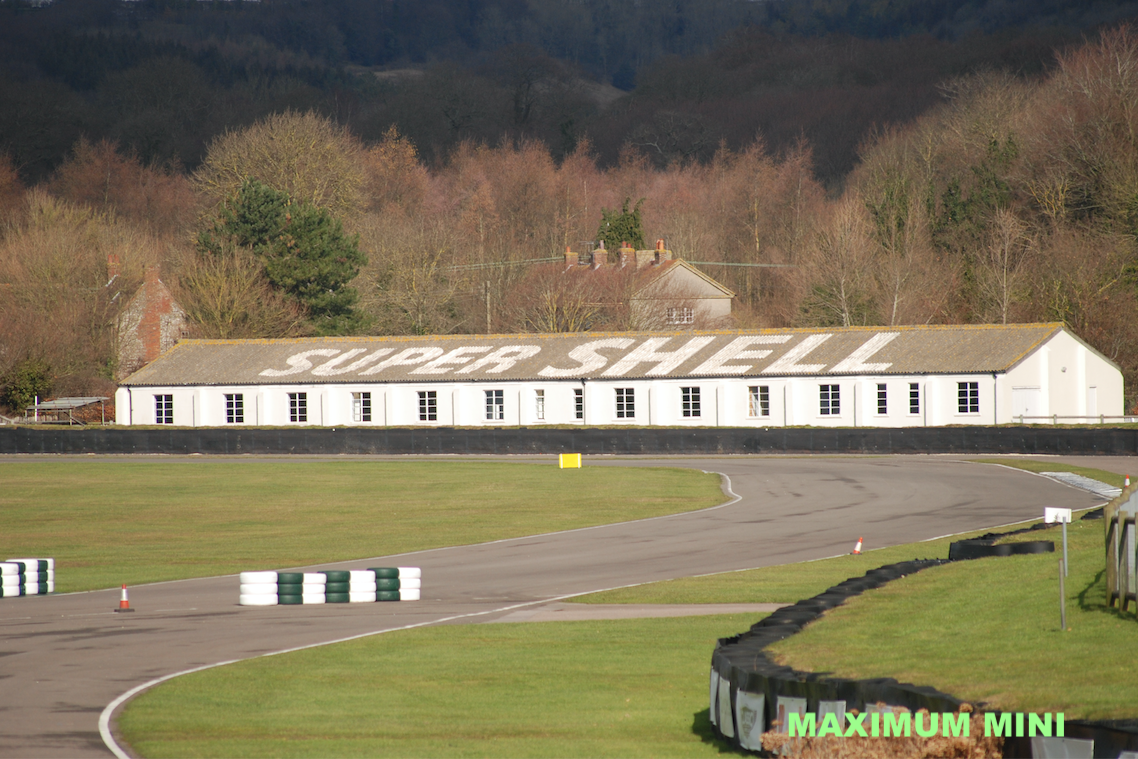
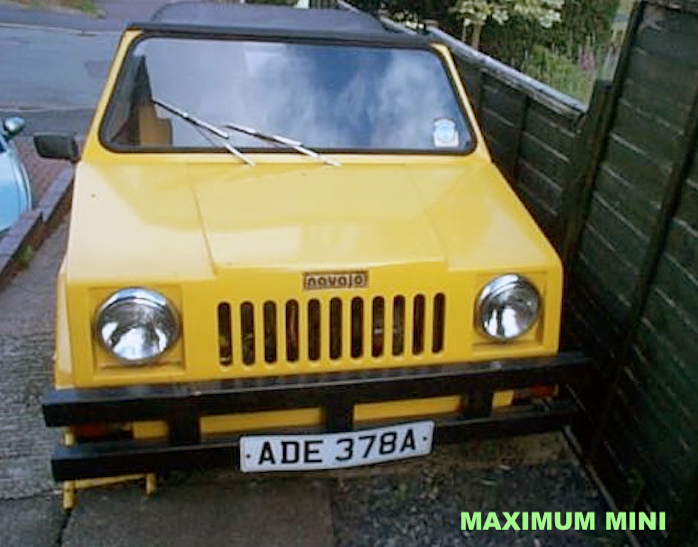
When a Navajo, or Langridge Navajo, was offered for sale recently I received a great number of messages about it and dug out the files again. The Navajo really was an interesting little car built between 1984 and 1985 by racing car builder Alan Langridge in his ‘Image Race Cars’ workshop at the Super Shell building, on the Goodwood grounds and just next to the track. The Duke of Richmond was a backer of the project and worked with Alan Langridge to get the Navajo on to the road. The car was originally based on the 1100 or 1300 but Langridge reputedly didn’t like the Hydrolastic suspension and converted the cars back to coil shock absorbers. A basic kit consisted of a mig-welded and zinc-plated monocoque with a fibreglass bonnet, windscreen, and all the necessary mountings, brackets, fixings, nuts and bolts. The Duke of Richmond was quoted: “I could have a lot of fun around the estate with this car”, but it’s unknown whether he ever had one. Langridge moved to South Africa in the late 1980s and later to France.

I wondered wether the car for sale was one I'd seen before. It wasn't and I decided to make a list of cars that I know about. Supposedly 12 Navajos were made and have pictures of 10 of them, while one of these - the prototype - has been confirmed scrapped. Know more? Let me know.

SWY 185 was the Navajo demonstrator / brochure car. It's been scrapped
Picture Jeroen Booij archive

The Navajos were built by Langridge's Image Race Cars in Goodwood's Super Shell building
Picture Jeroen Booij archive

SWY 185

ADE 378A

TSN 442M

Q279 EGV

Q413 NTR

Q494 XUX

Q580 CGY

Q621 FVT

Q683 CGY

Q627 ODW

Wednesday, 15 June 2022

The Badsey Eagle: what happened to it?

I found that the Badsey Eagle was never featured on these pages, so why not do a little write-up about it now? Perhaps anyone can also tell wether the car survives, too? 

William 'Bill' Badsey had been a furniture designer before he tried his luck with a sports car in 1978. It was based on the 1100/1300 range rather than the Mini and was a sharply styled two-seater with a Targa roof. The body was a fibreglass monocoque unit with steel reinforcement bars and was luxuriously equipped with electric windows and an onboard computer rather than the usual gauges. But the Eagle prototype was only just finished when Badsey emigrated to South-Africa. There he came up with a new vehicle: the wild Badsey Bullet three-wheeler with Suzuki GSX motorcycle engine. That generated a lot more attention than the Eagle, which was soon forgotten.

The sole Eagle prototype is believed to survive in South Africa though, but I have never seen any evidence of that. Who knows..?

 
The Badsey Eagle was made in the UK but moved to South-Africa with its builder Bill Badsey
Picture Jeroen Booij archive

The 1978 car was based on the BMC 1100 or 1300 using a fibreglass monocoque shell
Picture Jeroen Booij archive

But once in South-Africa Bill Badsey concentrated on the '81 Badsey Bullet. Note SA plate
Picture Veloce.it

Friday, 22 October 2021

Magnum Spectre survivor

A picture of the second (of two) built Magnum Spectre was posted on Facebook this week. The car appears to be fully restored and I'd love to hear more about it. 

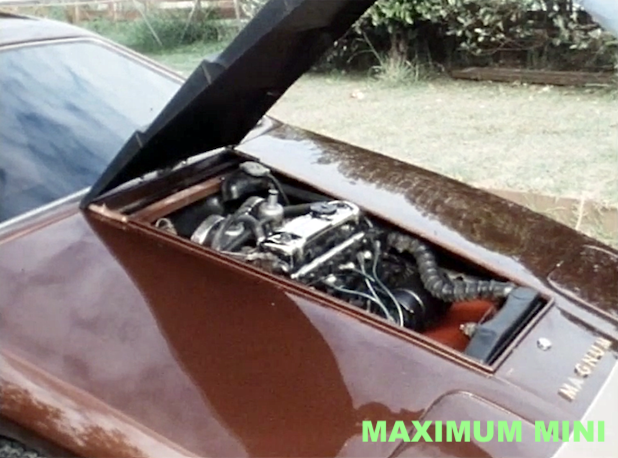
The two Spectres were made in the mid-1970s by carpenter Rohan Ash and his mate Arthur Wilshire of Auckland, New Zealand. They bought two written-off Leyland 1100s, one for each, and started work on the cars that were inspired by the Alfa-Romeo Carabo concept car. A magazine article was their only reference. Floors and mechanicals were retained, including the hydrolastic suspension and drum brakes, but they replaced the 1100 engines with 1275s from Mini Cooper ‘S’s. Some 30 metres of 25mm square section steel tubing was used to make a frame to place over each of the 1100 floorpans. The car’s bodies were made in fibreglass. Scissor doors like that of the Carabo were deemed to complicated and so Ash and Wilshire settled for more conventional opening doors. The hexagonal pattern of the rear lights, made of two layers of polycarbonate, proved to be another challenge. The interior was a mix of Mini, Datsun and home made parts. Once finished the duo offered replicas for sale from $8,500 but soon decided it would be too much work for them to run the business and deliver the kits. 

Both Ash as Wilshire used their cars on a daily basis for many years. Ash supposedly gave his to a museum in 2003, although it ended up in private hands some time later. Wilshire moved to Australia, taking his Spectre with him and the car seen on the Facebook picture is his car, on a Queensland plate with appropriate 'O KIT 2' number. It's now painted bright orange and has undergone some changes. It's got bigger wheels and wider arches while the pop-up headlights have been replaced by more conventional units. I wonder if it is still owned by Wilshire?


The Magnum Spectre of builder Arthur Wilshire was spotted in Australia recently
Picture Facebook via Paul Kelly

The same car when it was just finished in 1976. The pop-up lights still there
Picture Jeroen Booij archive

Wilshire's Spectre was originally a deep brown metallic and wore a NZ plate 'IC 1520'
Picture Jeroen Booij archive

Although it was based on an Austin 1100, the engine was a 1275 Cooper 'S'
Picture Jeroen Booij archive

While the very luxurious interior was a mix of Mini, Datsun and home made parts
Picture Jeroen Booij archive

This is the first of the two Magnum Spectres, the one used by Rohan Ash. Note different bonnet
Picture Patrick Harlow / Jeroen Booij archive

Ash and Wilshire marketed the Magnum Spectre in 1976 but never made any others
Picture Jeroen Booij archive

Monday, 9 December 2019

Wellington mystery Special survives - only just

When Jud Chapman saw a car he didn't recognize at the local wrecker's yard in Horopito, New Zealand, he took some photographs of it and posted the picture online. it didn't take me long to recognize the car as the mysterious 'Wellington Special' described in Maximum Mini 3 and also here with a picture of Graeme Farr. Graeme was quite sure the car had been scrapped after having photographed it in the 1990s, but apparently it survives - only just!

And that was not all to the story. Another New Zealand enthusiast, Bob McBurney, saw the pictures, too, and also recognized the car as he'd even been a former owner. He added: "It's an Eclipse based on an Austin 1300 floor pan supposedly to look similar to a Lotus Esprit. I was told it came from Britain as a kit with 1100 or 1300 floor pan and running gear, but I'm not sure. It was in primer when I got it and had pop up headlights using a wiper motor. I ran my 1430 mini motor in it for a bit of fun. Guys didn't know what just passed them! I owned it over 30 years ago but it had rust in the floor pan so I moved it on. It definitely turned heads, pity the floor pan was rotten. Amazing it's still around, I totally forgot about it. I would have liked to know who built it."

Graeme Farr, who thought it had been scrapped decades ago added: "Wow, who would have thought! I think it had a council towaway sticker on it when I saw it. I thought it had just been abandoned there as it was the end of a dead end street. Good to see its still around. A friend (has a Mk1 Cooper S) sometimes looks after a hotel owned by the same owners at the Horopito wreckers and I will ask him where it came from."

So there we go again... Who knows more about the car that's now identified as the Eclipse? And last but not least - will somebody see the potential of it and save it from the scrappers after all?!

Wellington mystery Special is found at a wrecker's yard in Horopito, New Zealand
Picture Jud Chapman

This is the same car decades ago, and believed to have been scrapped since this picture was taken
Picture Graeme Farr / Jeroen Booij archive

It has much deteriorated since but at least survives. We now also know it was named Eclipse
Picture Jud Chapman

Austin 1100 base is visible in original Blaze Orange. Somebody save this vehicle!
Picture Jud Chapman

Thursday, 25 July 2019

Healey WAEC - More info wanted

Some of you will know that Donald Healey - of Donald Healey Motor Company fame and the man behind the Nash-Healeys, Jensen-Healeys and Austin-Healeys - tried his luck with a Mini based car also. His roadster was in fact based on one of three hand built pre-production Mini prototypes and is now the oldest Mini alive.

However, it wasn't on its own. There was a later prototype - probably dating to 1965 - built to become a possible Sprite successor, which supposedly used a 1275cc Mini Cooper 'S' drivetrain, placed behind the driver and passenger. The car came with a Targe roof into which the hood cleverly could be folded away. It used a combination of Sprite (front) and Mini (rear) suspension with hydrolastic (note different wheels). Handling was said to be 'astounding', though less stable than that of the Sprite. The prototype was named WAEC for 'Wheel At Each Corner' and I have only been able to source one picture of it. Supposedly it never made production because BMC thought 'Sports car owners are too conservative'...

I have no idea if the prototype could survive. Over the years I have asked several Healey enthusiasts and connoisseurs for more information about the car, but no one appears to be able to tell me more than just this. Perhaps a message out here may help..?

UPDATE 29 July: Karsten Stelk asked Simon Bilbie at the Healey Owners Group, who replied: "There’s more information in David Matthews’ latest book. Originally codenamed U2 it was drawn up by my late father Barry in May 1965 and, as stated, was based on Mini and ADO 16 components. It was used as a general mule for a few years but then presumably scrapped."
Another comment mentions: "In Jon Pressnell's Austin Healey book, it is mentioned the WAEC prototype was in fact built around two 1100 front subframes completed with hydrolastic suspension and the 1100's rather low-geared steering, but with the benefit of thereby gaining a four-wheel disc-break system. It did appear to use a Cooper 'S' engine, even so the car was overweight and suffered from poor performance even with the Cooper 'S' unit. It also suffered from the old A-Series problem, which was the engine being on top of the transmission, posing difficulties with installation and with the gearchange."


Healey WAEC used Mini Cooper 'S' power and hydrolastic suspension
Picture 'More Healeys'

Thursday, 21 March 2019

Serra MG Crazy is perhaps not quite so crazy

You know I squeeze in an Austin or Morris 1100 based vehicle here every now and then and I think it's time for just another now. Keeping in with the Spanish theme of earlier this week (Mini Jaba, click here), let's have a look at the MG Crazy. This was an MG 1300 based car built by Spanish coachbuilder Pedro Serra.

I found out that Serra had been offering a plush variant of the MG 1300 (the Spanish version as built by Authi of Pamplona) for some time in the 1960s. This was called the MG 1300 'Equiped by Serra' and came with the usual lavish coachbuilder's stuff. Leather, wood, carpeting, chrome plus the necessary extras such as wheel covers, sun roof and foggies.

But it didn't stop there. In 1969 Serra launched a full conversion of the MG 1300, now named MG Crazy. This was quite something else. Again, it was based on an Authi built car, but all of its original body had gone to make place for a brand new one in the style of a 1930s roadster. Not unlike the Siata Spring which came sometimes earlier and certainly also not unlike the MG 1300 based Magenta, which saw the light of day in Yorkshire three years later. It really makes you wonder if Mister Magenta Steve Johnson (click here) was inspired by the Serra design!

Anyway: the car was launched at the 1969 Barcelona Motor show and Pedro Serra hoped for production. That didn't happen. It was relaunched two years later at the same show in a slightly modified variant - just visible in a movie clip (click here and see it at around 0:30). Still, it never became a succes. Supposedly because it was too costly to build. Just 3 to 6 MG Crazy's are believed to have been made, but I wouldn't be surprised if there were even less. One was on show on a Serra themed display at the Barcelona Classic car show in 2017 and that's the one seen here.
I would like to find out more. Who helps me?

MG 1300 'Equipped by Serra' was a coachbuilt version of the Spanish made Authi MG 1300
Picture todocolleccion.net


El Fabuloso - the fabulous - Serra MG 1300 has to be rare. Who did ever see one one?
Picture todocolleccion.net

And then there's this: the Serra MG Crazy, as seen on the 2017 Barcelona Classic Car show
Picture Pere Nubolia photography

Small retro roadsters were a thing in the late-1960s, early-1970s. Think Magenta, think Siata Spring
Picture Pere Nubolia photography

Neat interior cannot totally hide its MG 1300 origins. I wonder if its body is GRP or aluminium?
Picture Pere Nubolia photography

MG Crazy - that has to be one of the crazier names ever to have graced a car
Picture Pere Nubolia photography

This example was seen in Barcelona in 2017. Who knows more? Note historical photos left
Picture Pere Nubolia photography

A different car, or the same? This was taken during the 1971 Barcelona Motor Show
Picture RTVE.es / Filmoteca Espanola

Tuesday, 26 February 2019

Will Chambers Special ever drive again?

After over twenty years of neglect, things finally looked good for the Chambers Special in December last year. The 1967 designed and 1969 registered one-off is based on Mini and 1100 mechanicals and was the brainchild of engineer Michael Chambers. It’s an interesting car with some unusual features. Among them rear seats that face backwards, a heating and ventilation system, made to blow air through eyelets in all four of the seats, doors with built-in armrests, safety locks and strengthening for side impact plus a very clever adjustable steering column.

But it had become a ghost of its former glory after having been neglected since 1997. But then it finally found its devotee late last year, who was eager to get it restored. But things started to go wrong when the car was transported from Kent to Cheshire. The company that did so, lost the car's rear hatchback door in transit. The new owner, never the less, persisted to believe the Chambers Special deserved to be brought back to its former glory, and made plans to have a new rear door refabricated. That plan is still there, but sadly the project has been put up for sale once again never the less. Will the Chambers Special ever return to the road after all?

On its way to a new owner, when the future looked bright for the Chambers Special
Picture Simon Pike

Rear hatchback door is still in place here. But it got lost somewhere between Kent and Chechire
Picture Simon Pike

Interior had been stripped out, but moulded-in seats - facing backwards at the rear - are still there
Picture Simon Pike

A new home and new plans to get it back on the road, even if a new rear door had to be made
Picture Simon Pike

Mostly complete, too, but restoration is a daring task never the less. Who is going to do it?
Picture Simon Pike

Chambers Special is now on the market once again, looking for somebody to give it some tlc
Picture Simon Pike