Showing posts with label Ireland. Show all posts

Tuesday, 5 August 2025

Now in Maximum Mini Newsletter #84


I-Spy an Ogle SX1000 - in 1967 and 2025

More info and a picture of Irish Mini based Special turn up

Getting ready to take the Le Mans Mini Marcos to the UK
Tuesday, 4 October 2022

Mathijs finds an Irish Kingfisher Sprint

Mini Marcos owner and fellow-Dutchman Mathijs van Mullem lives in Ireland these days and he took his Marcos with him. He does send over a message every now and then. Last week a brief one came in: "Found a Kingfisher here in Ireland and bought it to play a little with". Wow! Doesn't that look like a nice example of the rare Kingfisher Sprint? Congrats mate, I'd love to hear more about it in due course!


'VFO 218' is a Kingfisher Sprint. About 35 of them were made in the early 1980s
Picture Mathijs van Mullem

The Kingfisher had a big rear hatch with a Datsun 120Y screen in it
Picture Mathijs van Mullem

Mathijs found this in Ireland, where he lives, and bought it to play with
Picture Mathijs van Mullem

He restored a Mk3 Mini Marcos, and drives that now in Ireland, too
Picture Instagram

Monday, 31 January 2022

The cars of Douglas Glover (4)

Some time ago I wrote about the cars built by Irishman Douglas Glover (part 1 here and part 2 here and part 3 here) and I intended to finish that off with a bit more about the man and his machines. Glover's very first car in particular, known as the DGS Special. I forgot that, but here it is now. 

To jog your memory: Glover worked as a production manager for Lincoln & Nolan, Austin agents for Ireland, which also assembled Minis for the Irish market. Glover came with the idea to create an Irish sports car, based upon the Mini. An Austin 850 meant for assembly served as a basis for the DGS Special, which was supposedly built in 1962 or 1963. It became a roadster with low doors and a boot, perhaps not unlike the MG Midget that had just come out and it is believed to have used several MG parts in the interior, too. The front also was adorned with an MGA sourced grille, with Mini headlights placed next to it and spotlights at the far corners. The car used the Mini’s bumpers.

It was registered 'LZC 775' (anyone who knows when? - UPDATE: Neil Kilbane does - it must have been around July 1961) and used for some local motoring events. Unfortunately I have only one picture of the car, kindly provided by Richard Heseltine, where it is seen frontally. Wouldn't it be nice to find out that there was more?


The DGS Special was in fact the prototype for the layer DGS Firecrest
Picture courtesy Richard Heseltine

The only picture I know of the Special was also used in The Autocar in April 1963
Picture Jeroen Booij archive

Grille is from an MGA, badge looks to be Austin? What happened to LZC 775?
Picture courtesy Richard Heseltine

Wednesday, 29 September 2021

Timeire on the Isle of Man

Stephen Callow dropped me a line titled 'Timeire on the Isle of Man (Hill climb circa '73)', which is certainly one good way to get my attention. 

Timeire was the name of a one-off Mini Van based Special built by Irishman Tim Conroy and his father Patrick 'Pop' Conroy in the late 1960s. After getting in touch with Tim Conroy's son Martin some years ago I found out that the car used a 998 Cooper engine and was raced by Rob Mason at Brands Hatch before well-known racer Gerry Marshall took it to the Isle of Man for a hill climb in 1970. Martin also told me it was sold as a road car in 1973 and was written off and scrapped about a year later. 

Where did Stephen find this superb shot? He wrote: "A contact shared a couple of hill climb pics – September 73 we think." So that would likely have been after Conroy sold it. Or could it be Gerry Marshall in 1970 after all? What's interesting also is that the car appears to have a registration that I have never seen on it on any other picture: '658 CXP' or '658 CXR'. What can we make of that..?


The one-off Mini based Timeire is seen here in a hill climb at the Isle of Man
Picture courtesy Stephen Callow

Detail shot seems to reveal registration '658 CXP' or is it '658 CXR'?
Picture courtesy Stephen Callow

Friday, 13 November 2020

Deep Sanderson 'Twini' at the drag strip

Ever-enthusiastic fellow-Biota owner Tim Harber sent me some material related to the illusive Deep Sanderson 105 'Twini' or 'Twinny'. What struck me most was a clipping from a 1972 issue of Cars & Car Conversions magazine that was new to me. It's an interview with Irishman James 'Jim' Gavin, who worked for Chris Lawrence in the mid-1960s and famously sprinted the Twini at the British International Dragfests at Church Fenton in 1964 and at Woodvale in 1965.

From the article: "Jim came to England and worked for Chris Lawrence, the Deep Sanderson man, whose brilliance and ideas and driving was wasted by accidents and financial disaster. Jim found fun in everything at LawrenceTune, but most of all in a racing TwinnyMini single seater. Jim doesn't say wether it went round corners, as he used it only for dragging. In 1964 when the first Great Britain versus America contests were held. "The car would do the 1/4 mile in 11.43 and at the end of the run would be pulling 115-118 mph. It earned me some money, and this was very handy when we started SuperSport." The car was lying around partly built, using four tubes tying the two subframes together, and the whole thing was run with 10" wheels. The two engine craze rather faded away after John Cooper had an awful smash on the Kingston bypass in a saloon twinny. The LawrenceTune car used two Downton 1071Ss, and possibly the arrival of the 1275S saved any more disasters."

What's more: Tim also sent a link to some film footage of these dragfests, in which Jim Gavin can be seen briefly in action with the Twini - see below and go to around 3:10 for the Deep Sanderson. What struck me here is that the car looks to be green. I have a few black and white pics of the Twini at the drag strip, but always thought it to be red. It was red with a black stripe when I photographed it for Maximum Mini 1, back in 2007, with absolutely no clues of any green paint on the body.


Irishman Jim Gavin at work on the Deep Sanderson 105, which used two Downton 1071 engines
Picture Cars & Car Conversions, via Tim Harber

Gavin at the wheel of the Twini during one of the Sydney Allard-organized 'Dragfests'
Picture jeroen Booij archive

Gavin said: "It earned me some money, and this was very handy when we started SuperSport"
Picture jeroen Booij archive

"The car used two Downton 1071Ss, and possibly the arrival of the 1275S saved any more disasters"
Picture jeroen Booij archive

Gavin was quoted to do the 1/4 mile in 11.43 at 115-118 mph - this clipping says it did 13.18 at 109 mph
Still pretty impressive for the Twini though
Picture jeroen Booij archive

As found in 2007 - the Deep Sanderson 105 was red then, with no traces of any green paint
Picture Jeroen Booij

Unseen film footage by Nick Pettitt shows it in action on the drag strip when it was green
Video courtesy Youtube / Nick Pettitt

Wednesday, 21 October 2020

The cars of Douglas Glover (3) UPDATED

Over to another DGS Firecrest, built by Douglas Glover of Dublin, Ireland in the 1960s.

The first Firecrest was described here in detail recently (click here) followed by the second car, which was used for PR activities and later raced and spectacularly crashed on a hill climb in Donegal (click here). This is number three of which unfortunately not much is known other than that it is supposedly a coupe. 

'KZE 999' is a Dublin County registration, issued somewhere between May 1963 and June 1964. Apart from having a closed roof the car is wearing different headlights then the other two with large chrome surrounds plus spotlights (Facel Vega!?). The picture below is unfortunately the only one that I have of the car.

UPDATE 24 October 2020: Eddie Fitzgerald dropped me a line as he knows more about 'KZE 999': "I have a memory of seeing it in the mid 1960s. Glover started a business a few miles from where I lived, I think the roof section may have been a one-piece moulding fitted onto the shell like a hard top. I have seen this photo before, and it is the only one I have seen of the car, which was either stolen and never found or written off in an accident with a truck. Regards Eddie."


The number 'KZE 999' belongs to DGS Firecrest number three
Picture Jeroen Booij archive, source unknown

Wednesday, 30 September 2020

The cars of Douglas Glover (2)

Douglas Glover of Dublin, Ireland, made just a few cars under the DGS banner and this is the second to take a more detailed look at.

After a first DGS Special, a buck / prototype for the DGS Firecrest and the first production car registered 'LZD 775' (full story here), the second DGS Firecrest became 'RZD 407'. It had a number of differences from the earlier car, for example the air intake on the bonnet and the lack of door handles. The car was used to shoot a number of publicity pictures and was seen in a few magazine articles.

What exactly happened in the first couple of years of the car's life remains unknown, but RZD 407 showed up in the hands of rally driver and hill climber PJ Wilhare in the late 1960s. By that time it used an extra air-intake and alloys, was bumper-less and was seen with a hardtop, too. Things went wrong when Wilhare entered the car at Knockalla hillclimb in Donegal in 1970. A fast left bend proved to be too much for the Firecrest and rolled at high speed. Somebody described it as follows: 'In a scene resembling an air crash Wilhare ended up sitting on the remains of the floorpan with the debris scattered far and wide.' What was left of the car was scrapped, but the crash made history as the fast left bend is christened 'Wilhare's Corner' ever since that day in 1970. Some more information on the Knockalla circuit and Wilhare's Corner can be found here.


DGS Firecrest production car number 2, seen here in a nice publicity shot
Picture Jeroen Booij archive

Original caption: "Motoring in Ireland on holiday can be leisurely enough to enjoy a 
friendly chat. On the road near Kilkieran, County Galway"
Picture Jeroen Booij archive

Even the donkeys are friendly in Ireland! Note standard wheel covers, an 850 base..?
Picture Jeroen Booij archive

Headlight covers made the Firecrest's nose even more aerodynamic. Standard Mini looks like a brick!
Picture courtesy Richard Heseltine

PJ Wilhare competed the car in a number of races with hardtop. Here at Kirkistown in 1969
Picture via Graemme Farr / Jeroen Booij archive

And here at Knockalla hill climb a year later. It was going to be the car's last outing
Picture Jeroen Booij archive

Seen here with PJ Wilhare behind the wheel in the fast left bend. Things were okay here...
Picture via 'Pictures from the Past'

... But then it went wrong. This shot is taken just after it crashed - the Firecrest is surrounded with spectators and is not visible, though. Competitors were making their way back down the hill. All that was left of the DGS was the floor!
Picture Eddie Fitzgerald / O'Kane cars

Thursday, 10 September 2020

The cars of Douglas Glover (1)

When a new picture of a DGS Firecrest was posted to me recently (thank you Graeme), I was kind of surprised to find I never wrote about these cars here before. And since I'm in a good mood I thought I'd do a little write-up here on all the DGS cars that I know of, starting with the first one now.

DGS stood for Douglas Glover Special, with Glover being the man responsible. He was in fact production manager for Lincoln & Nolan in Dublin, which were Austin agents and assemblers for Ireland. They also link to what is possibly world's very first Mini-derivative, too (click here).

Anyhow. Glover had built a Mini based Special in 1963, which became a forerunner to the Firecrest. More on that later - let's focus on the Firecrest for now. A buck for a new body and a mould were made by maintenance staff of Lincoln & Nolan, with fibreglass monocoque production bodies to follow. The car's sides certainly seemed Midget/Sprite-inspired, and the windscreen, side screens, soft top and rear lights were sourced from that model, too. A Midget or Sprite hard top could be fitted also, but may have been altered. The front used double round headlights were placed further back with the possibility of putting Perspex covers over them.

The first production car was registered LZD 775 in 1963 and is said to have used Austin Cooper running gear. Wheelbase and track were similar to that of the original Mini. Just two more Firecrest followed, more on these soon.

The buck for the DGS Firecrest, made by the maintenance staff of Lincoln & Nolan
Picture courtesy Bill Bell / Jeroen Booij archive

The sides were clearly Midget / Sprite inspired and the (altered?) hardtop fitted, too
Picture courtesy Bill Bell / Jeroen Booij archive

Wheelbase and track, however, were similar to that of the Mini itself
Picture courtesy Bill Bell / Jeroen Booij archive

The first DGS Firecrest production car was registered LZD 775, here on a great PR shot
Picture Jeroen Booij archive

Double round headlight were certainly distinctive. Sprite / Midget screen and sidescreens 
Picture courtesy Richard Heseltine

The car is seen here in Phoenix Park, Dublin during a 1963 MG Car Club trial
Picture Jeroen Booij archive

Wednesday, 13 May 2020

Jola and Grimes Autotest Specials

Autotest champion Alastair Moffatt - who recently purchased MoBi-One - found some more interesting Mini based vehicles in his photo files. He wrote:

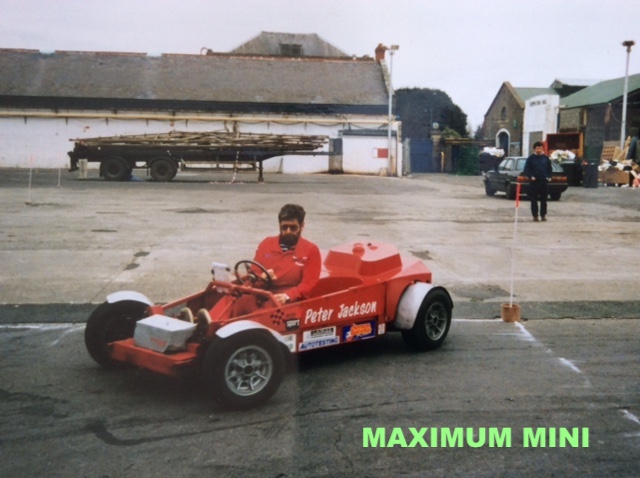
"Hi Jeroen. I found these pictures of an autotest car named Jola, made in late 1970s and running a Mini 1430cc engine in rear on fiddle brakes so a handbrake for each of the rear wheels to do a handbrake turn. It got stripped in 1999/2000 and all the suspension and subframes plus engine went into an ABS Freestyle as you have in one of your books. It shows it losing a wheel at the Royal Dublin show ground in 1998 on a international event."

"And I got another car for you. Peter and Chris Grimes from Southern Ireland made this Mini Special from a cut down Mini from the late 1970s. Front subframe bulkhead and floor to just behind the seat were retained and then the rear end with a made up rear beam bringing it to the same wheel base as a Mini but with no overhang. In the photo from around 1998 at Birmingham, it was running a 1380cc Cooper 'S'. A very very light car with great vision all round. It won around 8 Northern Ireland autotest test championships and 5 British RAC/MSA championships plus 3 BTRDA championships.
It is still going today but now runs a Vauxhall Nova engine in a mini subframe on 14inch wheels."

Jola Special, run by Peter Jackson, used 1430cc Mini engine at the back
Picture Alastair Moffatt

Hmm... Royal Dublin show ground 1998 - when it lost a front wheel in the heat of the moment
Picture Alastair Moffatt

Wheel found. The Jola Special used so called 'fiddle brakes' for easy manoeuvring
Picture Alastair Moffatt

And another Mini based Autotest Special - the Grimes Special, which does survive
Picture Alastair Moffatt

Wednesday, 15 April 2020

What happened to the electric Mini Marcos?

With more and more classic cars getting electrified these days, let's have a look at a Mini Marcos that had been modified in this way back in 1968. It was built by professors James Lacy and John Byrne who both worked for the department of electrical engineering at the University College of Dublin.

A quote from an article that I found: "The car was initially conceived as a research vehicle for Byrne's research into low-loss drive systems and Lacy's into control systems, but became a substantial project in itself, attracting support and interest from a number of companies. Extensive research was carried out into ways to minimize loss mechanisms, and the car incorporated regenerative braking."

According to the piece Lacy used it for his daily commute for some years to the campus at Merrion Street in Dublin, covering 20 miles a day at a top speed of just over 30 mph, using it as a rolling test bed to evaluate several motor control systems. The professors were jointly awarded the Mullins Medal by the IEI in 1970 for a paper on this subject. Now, about the car: was 'HZO 888" an Irish built Mini Marcos in the first place? I also wonder what happened to it afterwards..?

Professors James Lacey (left) and John Byrne with their electric Mini Marcos
Picture University College Dublin

Lacey used the car as a daily driver for a number of years. Its top speed was 30mph
Picture University College Dublin

Tuesday, 8 January 2019

Odnik sketch found

You guys know I am a sucker for new discoveries. And there are several cars which I'd love to find one day. One of them is 'Odnik': an Irish-built Mini based roadster, raced (and built I'd say) by Jack O'Donoghue in 1961. What's so special about it? Well, I really believe this car was based on a 1958 Mini prototype of which not a single copy is known to survive. You can read more about it here and here.

Now. So far, all traces to the car itself have led to dead ends. But at the end of the year I was contacted by Trevor Ripley, who'd just bought an old Austin Seven 850 dealer pack and found something interesting in it... Trevor wrote:

"Hi Jeroen. I bought an old Austin Seven 850 dealer pack off an ex Longbridge employee. Included with it were these original photos of what you call the DGS firecrest / Special (more about these later-JB). I have just been going through the dealer pack and discovered on a blank page a pencil sketch of a similar car. From my memory I have seen a picture of another soft top Mini derivative a while ago, also registered in Ireland. A similar car to the Donald Healey car (chassis 102). Could this car be connected with Doug Glover? The pencil drawing looks very similar with an ordinary Mini front and rear styling similar to 102. Best regards, Trevor."

Well, well, if that isn't Odnik! Note the cut doors, elongated bonnet, soft top and of course that much-modified rear end. Fact is now that it was not based on an early Van. All this got Trevor exited, and me too! Trevor came back on it: "It would not surprise me at all if Odnik was originally a prototype. BMC would certainly have initially sent a Mini to Lincoln & Nolan as a sample to set up the assembly line. One of the prototypes which were not longer required at Longbridge would make sense." Trevor also got back to the man he bought the dealer pack off: "I have just telephoned the guy I got it all from, Les Gammon, to check if there was anything else he could remember but he has already told me all he knows." So there we go. It only strengthens my thought about Odnik being a 1958 Mini. The question remains: could it survive..?

The Odnik sketch found in a an old dealer pack formerly owned by a Longbridge employee
Picture Maximum Mini archive via Trevor Ripley

The dealer pack in question, signed by... Jack O'Donoghue....
Picture Maximum Mini archive via Trevor Ripley

The only picture I can find of Jack O'Donoghue (center) is taken in September 1960
Who knows more about this man, who was PR Officer at Lincoln & Nolan in Dublin?
Picture Irish Photo Archive

Monday, 29 October 2018

1967 works Mini Marcos: an update

Thank you all for the comments coming in on last week's article about the Mini Marcos, believed to be the 1967 ex-works racer and Le Mans car (click here when you have missed it). Well, it seems it is not that, although it is an ex-works car. This is how the nut was cracked.

The other car, you ask? Yes, there was a second works racer built to the same specifications. Works mechanic Mike Treutlein told me back in 2011 that they built two near-identical cars, one metallic green and one primrose yellow. The first was used by a men's team and became the 1967 Le Mans car. But the second was never used at Le Mans. It was raced by a ladies team: FLIRT - for First Ladies International Racing Team. Drivers were with Jackie Bond-Smith, Joey Cook and Jacqui Smith. It was raced at the Nurburgring in Germany, Mugello in Italy, Phoenix Park in Ireland and probably at several more venues.

It is recognizable by its squarish front wheel arches, just have a look at the several pictures in the previous article and below here. Both cars were raced at the 1967 Nurburgring 500 kms race, as at Mugello. Reader Edward Fitzgerald adds that they were also both seen at a race at Phoenix Park in Ireland in September 1967. Fitzgerald: "Jem Marsh drove this car at Phoenix Park September 67; Tim Lalonde drove the green car."

I now also know that the car was sold in 1968 to Macau and sold once again to Japan in 1971. In fact the Japanese owner contacted me also, writing: "I seemed to buy this Marcos in Macao in 1971. He sent a photograph of it also, but added: "Because it is a publication, please do not publicize it." I won't. But it's good to know more about it now. And it does indeed seem that both cars built by Marcos Cars had their windscreens changed. The green Le Mans car first, the primrose yellow FLIRT car soon after it.

This is the picture that made the ball go rolling. This is the ex-works car at the Macau Grand Prix in 1969, but is the FLIRT car and not the Le Mans car
Picture Carros Classicos de Macau

Only colour picture of the car that I know of. Here at the Nurburgring 500kms in 1967.
The windscreen is not yet modified here
Picture Werner Ullrich

But look carefully and you will see it is here. This picture was taken at Phoenix Park, Ireland, in September 1967. The other works racer was supposedly raced in the same race by Jem Marsh
Picture via Edward Fitzgerald 

The girls from FLIRT: Jackie Bond-Smith, Joey Cook and Jacqui Smith in 1967
Picture still from British Pathe movie

Once more at the Phoenix Park race in 1967. The other works racer, the green 
1967 Le Mans car, was there also, says reader
Picture Irish Photo Archive


Tuesday, 13 March 2018

Found footage: Radford Mini stars in 1966 horror movie

Several years ago I got hold of some original Radford photographs. Among them two shots of what appears to be an early Radford Mini Bel Air or De Ville on Irish (Dublin?) plates. On these pictures the car seems to be parked in a studio setting and one of them strangely shows it with a flat front tyre. I had no idea what it was about but thought it may well have been used for a movie. Chances of finding it were ultra-low, I thought.

Imagine my surprise when I was looking at the 1966 movie 'The Psychopath' last week, which opens with this very car in this very setting! It also explains the flat tyre. The Psychopath is a horror movie by Amicus Productions, also known as the studio that dripped blood, and together with Hammer my all-time favorite movie producers (I have a real taste for classic British horror). The full film can be found on Youtube, and I have enclosed it in here, too. The Mini scene follows right after the opening titles. Enjoy!

This picture of a Radford Mini De Ville was a mystery for many years. It's on Irish plates
Picture Jeroen Booij archive

Shown here with a flat front tyre in a studio setting, it now turns out to be part of ' The Psychopath'
Picture Jeroen Booij archive 


Video courtesy youtube.com

Thursday, 21 September 2017

Odnik: Indeed based on a 1958 prototype Mini?

Two more pictures of 'Odnik' - the Irish built Mini special that was raced by Jack O'Donoghue in 1961 (more about it here), have come to the light thanks to Irishman Aidan Mc Grath. And I believe we can now almost surely say the car was based on a 1958 Mini prototype. The stamped grille of the car is the first giveaway, as there were only two Mini variants that had this feature: the 1958 prototypes and the Mini Van (announced in June 1960). Odnik could well have been based on an early Van, but the registration points towards something else. 'CZA333' was a Dublin registration from November 1959. Apart from prototypes, there were no vans at this time yet. 

What's more, judging from the old photograph that I found and the new ones that Aidan came up with, I don't believe this car to use the longer wheelbase of the van. It looks like a saloon to me, and the same goes for the rounded rear, with the filler cap on the left. This looks like it was converted from a saloon rather than from a Van to me. Or is it? '59 Mini Register man Bill Bell said of the first photograph: "Looking at the wheel base it looks like its a modified Van. I doubt very much it's a 58 prototype. They were all in such poor state after they had finished testing and as far as we know all were scrapped." 

I'm not so sure. Jack O’Donoghue worked for the Austin importers/assemblers in Dublin and may have been able to get hold of a '58 prototype Mini. Minis were built under a license in Ireland from as early as 1959. Fact is that O'Donoghue got rid of the car’s roof, modified its rear end in steel, cut the doors, lowered the handles and fitted a Sprite windscreen. He won his class during a Hewison Trophy qualifying trial in December 1961. Could the car survive? And be found? That would surely be sensational...

UPDATE 13:00: An avid reader drops me a line: "I spoke to the last known owner of the car and he can't recall what he did with it, but thinks he scrapped it. I am due to meet a previous owner next week, who used the car in the UK in '65/'66 before bringing it back to Ireland and selling it. I will ask him for his thoughts on the history of the car, as he would have known Jack."

UPDATE 8 January 2019: A sketch of the car has resurfaced, making clear it was definitely not based on an early Van. Read and see it here.

Jack O'Donoghue in action in his Odnik in December 1961. This was the only known picture of it
Picture Jeroen Booij archive / Autosport magazine

But then Aidan Mc Grath came up with this. Stamped grille points towards 1958 Mini prototype, as does wheelbase? 'CZA 333' is a november 1959 registration
Picture via Aidan Mc Grath

Odnik's rear was modified quite heavily, too. Again, the round shape points towards a saloon to me, as does the filler cap that is positioned at the left hand side
Picture via Aidan Mc Grath