Showing posts with label South-Africa. Show all posts

Tuesday, 14 October 2025

Now in Maximum Mini Newsletter #93


Buy a new Beach Car body on... Alibaba!

South-African Cox GTM - where is it?

Linking the Ranger and the Lotus

Wednesday, 4 June 2025

Now in Maximum Mini Newsletter #77


Not one but two Bulanti Minis found in Australia!

New pictures of that Mini Marcos in Africa emerge

A very sunny Cub Six, also known as the Sundancer

Tuesday, 17 September 2024

Now in Maximum Mini Newsletter #42


How a lost Outspan Orange Mini turned up again

The Biota in the field - still there!

O'Youngs Unipower GT at Macau - where is it now?

Wednesday, 31 August 2022

Endless summer of 2022

August 2022 appears to have seen more classic car shows and meetings than the two years preceding it. A collection of sunny pictures made it to here a couple of weeks ago (click) - here are yet more of them that I came across or that were sent over in the last month or so. Keep them coming.
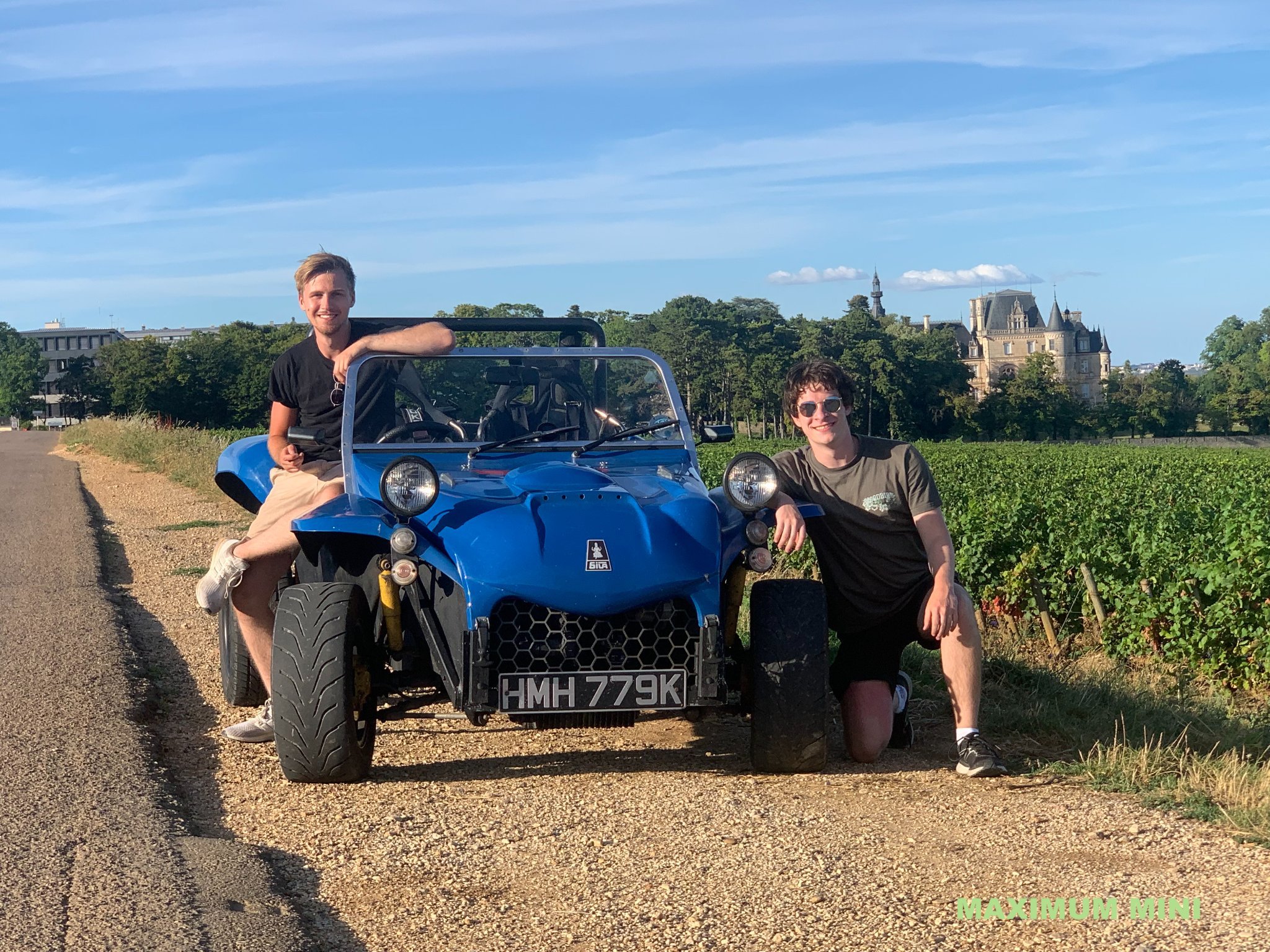

Matt Butler's son took his Siva Buggy for a trip. Matt: "Dad, can I borrow the Bug to go camping with a friend? Hmmm. OK - but be careful and don't go too far. One week later they're at the seaside!"
Picture via Matt Butler

Matt again: "England, Belgium, The Netherlands, Germany, Switzerland, Italy, Monaco, France. Now at Calais, the adventure is nearly over. Don't doubt the next generation!" Well said and well done boys!
Picture via Matt Butler

A very nice Mk1 Scamp seen on Malta. I believe it is for sale, too
Picture via Andy Turner

Many more Scamps made it to a meeting in Stourport last weekend. 
This Mk2 was pushed to the limits during the event 
Picture Becca Sydney

The number of cars attending the Scamp meet was impressive. Here a nice Scamp six-wheeler
Picture Roman Byk

Speaking of which... This Andersen Cub six-wheeler on Spanish plates was spotted last week in France
Picture via Thomas Laurent

And yet another Anderson Cub six! This time on Portugese plates and spotted at the 
All British Field Meet in Ontario, Canada
Picture Burton Reif

Last weekend in The Netherlands - the Euregio Meeting saw Mini Marcoses, Midases and Pimlicos.
Unfortunately I couldn't make it to the event. One Midas owner drove all the way from Tallinn, Estonia!
Picture Rolf Roozeboom

The Causeway Coast Mini Show in Northern Ireland saw a variety of Mini derivatives. This is an Indespension Jiffy that was turned into a camper van. Nice!
Picture Neil Kilbane

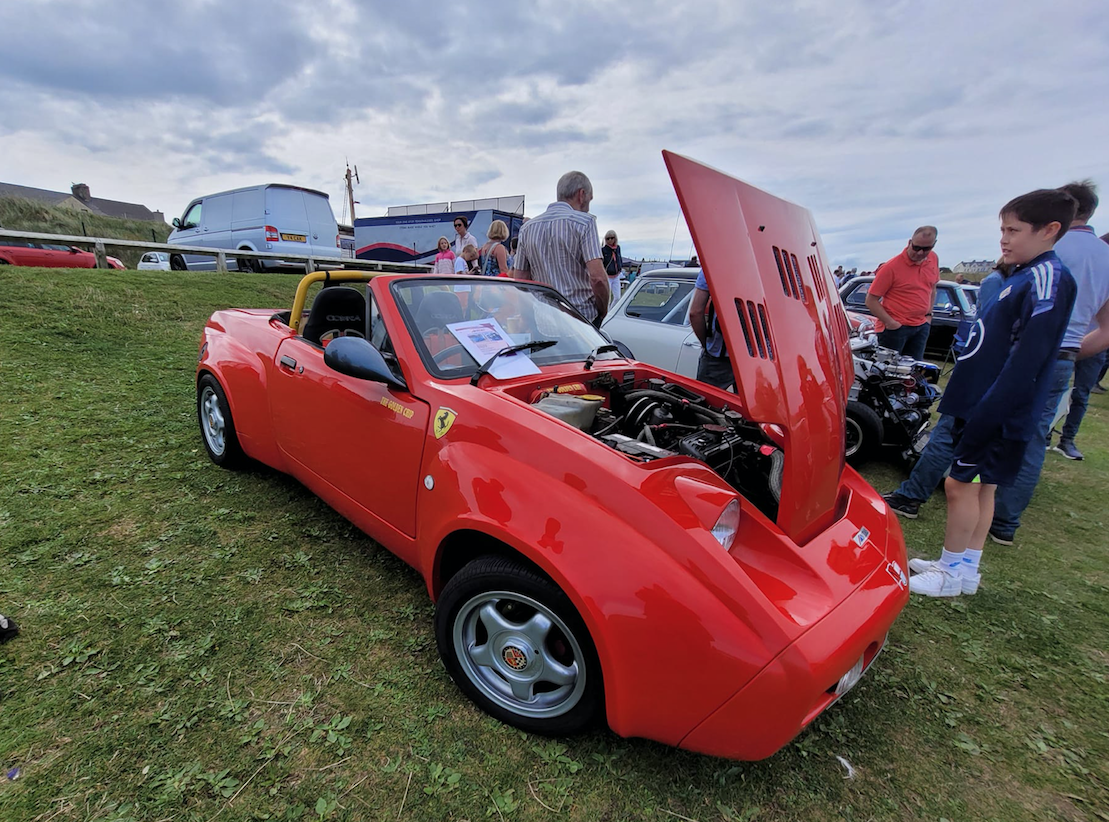
These cars are facing the Atlantic Ocean. Here a Midas Gold convertible disguising as a Ferrari
Picture Neil Kilbane

A rarity on its own, this particularly good looking Onyx Tomcat also at the Causeway Mini Meet
Picture Neil Kilbane

The Whitby Morrison 'Batman Special' ice cream van of Andy McPhail at the 
Dorset Steam Fair last weekend. Look at that shadow!
Picture Andy McPhail

If there's one person who continues to surprise me with his finds in South-Africa it's Leon Daniels. 
This is his latest discovery: an Elswick Envoy in highly original condition
Picture Stuart Neil Greig

How about this for a parting shot? An RTV at the Scamp meeting in Stourport on a beautiful night
Picture Tyler Hughes

Wednesday, 15 June 2022

The Badsey Eagle: what happened to it?

I found that the Badsey Eagle was never featured on these pages, so why not do a little write-up about it now? Perhaps anyone can also tell wether the car survives, too? 

William 'Bill' Badsey had been a furniture designer before he tried his luck with a sports car in 1978. It was based on the 1100/1300 range rather than the Mini and was a sharply styled two-seater with a Targa roof. The body was a fibreglass monocoque unit with steel reinforcement bars and was luxuriously equipped with electric windows and an onboard computer rather than the usual gauges. But the Eagle prototype was only just finished when Badsey emigrated to South-Africa. There he came up with a new vehicle: the wild Badsey Bullet three-wheeler with Suzuki GSX motorcycle engine. That generated a lot more attention than the Eagle, which was soon forgotten.

The sole Eagle prototype is believed to survive in South Africa though, but I have never seen any evidence of that. Who knows..?

 
The Badsey Eagle was made in the UK but moved to South-Africa with its builder Bill Badsey
Picture Jeroen Booij archive

The 1978 car was based on the BMC 1100 or 1300 using a fibreglass monocoque shell
Picture Jeroen Booij archive

But once in South-Africa Bill Badsey concentrated on the '81 Badsey Bullet. Note SA plate
Picture Veloce.it

Monday, 20 December 2021

Boxing Day 1967 - with Best Wishes from Checkers

A copy of this leaflet, which I'd never seen before, was sent to me by Joost van Diën. Yes, that's the 1967 Le Mans Mini Marcos works car with its modified windscreen. It's seen here during its time with South-African racer Peter Kat, who was sponsored by Checkers - a South-African supermarket chain. Kat's first race in the Marcos took place at the Roy Hesketh circuit on Boxing Day, December 26th, in 1967. Checkers certainly seem to have had good faith in him. Kat and his c-driver Dirk Marais came 11th overall. 

Last year in July I incidentally caused a bit of a stir when I wrote about this (originally green) car and its (originally yellow) sister car, mixing them up. There was a good excuse though. It turned out that the yellow Mini Marcos had received a signature modification also: its windscreen was modified just like the one on the green car, somewhere between 19 June and 23 July 1967. A comprehensive new article with many pictures followed, which you can still read here. Meanwhile a few more pictures of the car during its Checkers sponsorship have turned up, one of them showing it in its colours (here). Keep them coming!


Peter Kat drove the ex-works 1967 Mini Marcos in South-Africa with Checkers sponsorship
Picture via Joost van Diën

Tuesday, 22 June 2021

Brian Raubenheimer passes away at 80

I heard about the death of South-African racing driver and Mini Marcos manufacturer Brian Raubenheimer yesterday, who passed away at the age of 80. Brian started racing at 22 in an Opel Kadett but also drove a Lotus Elan and a Lotus Type 20 formula junior in South-African racing.

The Mini Marcos crossed his path when he met Chris Lawrence during a visit to the UK in 1967, who was working on the Le Mans car for that year. Raubenheimer, 27 years at the time, was attracted by the design and decided this was the car he wanted to built as a manufacturer himself. He managed to make a deal with Marcos Cars' Jem Marsh and completed a course at the Marcos factory in Bradford-on-Avon that same summer, learning all about moulding in fibreglass in preparation for his own manufacturing plant in South-Africa. To do so he moulded and built a car for himself and had that shipped over to South-Africa. A motoring magazine report: "It arrived by mailship in late July (1967-JB) and it immediately caused a stir in Durban and Pietermaritzburg. It is painted bright yellow. This particular car started life as a 1961 Mini Van which Brian purchased for R100 at Earls Court. It had 80,000 miles on the clock before he toured the continent with it and then stripped it to build the Marcos."

Apart from his own yellow car the shipment included a brand new set of moulds plus six more Mini Marcos shells also. In his hometown of Pietermaritzburg Brian set up Raubenheimer Manufacturing Company (Pty) Ltd although fabrication of the shells was outsourced to Ashley Smith's Plasba (Pty) Ltd in Estcourt, some 60 miles further up north and Brian regularly went there in his Piper aeroplane. The South-African built Mini Marcos Mk3 was officially launched on January 3rd 1968 at the Estcourt factory. At the time the six UK-built shells were built up as cars, too, and there were another 13 locally made shells to be seen. In November 1967 the '67 Le Mans Mini Marcos came over to Africa and was arced at Kyalami by Jem Marsh and Raubenheimer. The car never got back to the UK and was continued to be campaigned in Africa. It is still there today (extensive history here).

Sadly, a disagreement with Marcos Cars in the UK soon spelt the end of South-African production. Initially even the moulds were ordered to be destroyed, but Raubenheimer managed to prevent this. But by December 1968 the South-African dream had fallen apart, all the manufactured cars were sold and the factory had closed. According to one source a total of 63 cars are said to have been made, 47 of which with shells made in Estcourt, but I wonder if this is true. The South-African Mini Marcos moulds turned up in 2017 here. Raubenheimer himself remained active in the car scene up until recently.


Brian Raubenheimer with the bright yellow car he moulded and built himself at Marcos Cars in the UK
Picture Classic & Performance Car Africa

Left to right: Brian Raubenheimer, Jem Marsh and Brian's father Rufus Raubenheimer 
Picture Classic & Performance Car Africa

The factory in Pietermaritzburg, with a number of finished shells waiting to be completed
Picture Classic & Performance Car Africa

Mini Marcos delivery African style. 47 shells are said to be produced in Estcourt, SA
Picture Classic & Performance Car Africa

Brian Raubenheimer behind the wheel of the 1967 Le Mans Marcos at the Kyalami 9-hours race
Picture Jeroen Booij archive

Great start! Raubenheimer drove together with Marsh and they came 15th overal and 3rd in class
Picture Jeroen Booij archive

Brian Raubenheimer remained a real motoring enthusiast until his death
Picture Facebook

Tuesday, 4 May 2021

Tertius van Zyl passes away

I am sad to hear about the passing of Tertius van Zyl of South-Africa on May 1st. Tertius was the man behind the one-off Banshee that was sold just a week earlier, but he was also a former Mini Marcos owner and a much-respected member of the Mini Owners Club of Southern Africa. 

When his Banshee was offered for sale after 52 years of his ownership (here), he'd typed out the specification in much technical detail, but not forgetting to add some whit: "Banshee was born out of the need to have something to compete in the the (then) Sports Car club's racing class that was clearly beyond the capabilities of my well rallied and raced, mildly tuned 850 Mini in the early 1960’s."

He made no secret of his inspirations, too: "Inspired by a road report in CCC of the Unipower GT, I set about 'borrowing' some ideas from that source and a terrific book called 'High Speed Low Cost' by Allan Staniforth. (...) A visit to the then Cox GTM factory in Manchester cured my problem with the acquisition of a set of their prefabricated lower wishbones, with built in negative camber, that effectively lock the uprights in the right direction."

He sold his Mk3 Mini Marcos before as he'd sold his 998 Mk1 Cooper, but kept Banshee until days before his death: "Considering the old girl was designed over 50 years ago with construction having taken about 12 years (I was transferred around the country a lot in my airline sales job) and first being road registered in 1980 in Pinetown, she continues to provide a lot of fun for my two sons now in their 40’s who were just a twinkle in my eye when Banshee was born. I quite enjoy her company too!"

All the best wishes and condoleances to Tertius' family and friends. He will be much missed in the Mini (derivatives) scene also. 


Tertius van Zyl with Banshee - the Unipower GT inspired car that he built as a youngster
Picture via Gary Johnson-Barker

Tuesday, 23 March 2021

One owner since 1969: Banshee is now for sale

What do you do as a South-African youngster who's hankering for a Unipower GT? Well, back in 1969 Tertius van Zyl started building his own take on the Unipower, eventually christening his creation Banshee after 12 years of hard work. But what do you do when you're getting old and cannot climb in anymore? Well, Tertius has decided he may now sell his beloved Banshee after more than 50 years. Gary Johnson-Barker contacted me about Tertius' plans. In his own words: 

"'Banshee' was born out of the need to have something to compete in the the (then) 'Sports Car' club racing class that was clearly beyond the capabilities of my well rallied and raced, mildly tuned 850 Mini in the early 1960’s. Inspired by a road report in Cars & Car Conversions of the Unipower GT, I set about 'borrowing' some ideas from that source (spot the resemblance?) and a terrific book called 'High Speed Low Cost' by Allan Staniforth - the building of a 140mph Mini based single seater. The body originated on the drawing board. A 1/10th scale model was built to check the lines and a full size egg box style frames were cut from plywood and aligned on the chassis. Chicken wire, sackcloth and 500lbs of plaster of Paris was used to shape the body over the frames. This was then moulded in fibreglass as a female mould (subsequently destroyed - damn!) and the final body panels were moulded. Paint was applied with a small electric spray using a two part 'Poly' kindly supplied by a mate at the Dulux Plant! The chassis can best be described as a monocoque/semi stressed skin. Actually this means trapping two Mini front subframes in a lattice of 1 inch square steel tubing and 'popping on a sheet of aluminium across the bottom and up the sides to form two sill pannier’s."

"Suspension is pure dry Mini with the front cones having been machined to remove the 'pot bellied' look and then drilled to resemble a Swiss cheese in order to soften the spring rate. Rear suspension started out with the Mini uprights turned upside down with the retained steering arms connected to the lower suspension arms. This arrangement caused some interesting steering moments with the back of the car inclined to want to do it’s own thing in cornering and over bumps. A visit to the then Cox GTM factory in Manchester cured my problem with the acquisition of a set of their prefabricated lower wishbones, with built in negative camber, that effectively lock the uprights in the right direction. Brakes are drums all round, twin leading in front and singles at the back. Rear backplates had the centre hole enlarged to fit over the front uprights being used. All this to accommodate the hand brake system (with racing in mind, I wasn’t going to bother with a handbrake but at this stage of construction I got engaged and the idea of racing was banned from conversations! - hence the need to convert my thoughts to a roadworthy vehicle). Hydraulics came via a 1960’s Ford Cortina dual system master cylinder and the same donor was used for the clutch. Used because Mini cylinders being upright in design, would have stuck through the bonnet! Fuel for the two 1 1/4 SU’s comes via a Mini Van tank located behind the seats - thinking of weight distribution - with cut off switch on the centre console to stop the pump doing it’s thing while working on live electrics or ignition. Cooling is taken care of from a front mounted Triumph Spitfire rad through aluminium pipes and a Renault 5 electric fan. A feathering fan was a later addition on the engine side that cured a tendency to run hot in traffic."

"The windscreen - or more correctly the wind deflector was moulded from perspex over a wooden mould. Stuck into a friendly sign maker's oven were it conveniently draped itself rather well over the mould. Imperfections were sanded out and the whole thing 'Brasso'd' back to its former self. The lump at the back started life as a standard 998cc from a scrapyard but over the years its specs have changed to 998 Cooper. 948 Cam, larger inlets with double springs, 9:1 compression and twin 11/4 SU’s with ram Stacks. The head being gasflowed and ports enlarged. Final drive remains at 3.7 but 3.44 would be better as the low weight of the car sends the revs up rather smartly and open road cruising would be kinder to the motor that is pulling in excess of 5000rpm at the legal limit. Exhaust is a tuned length to preserve back pressure, via a Cooper manifold and two straight through boxes. Gears are changed using a sawn in half early Mini remote extension, with the gear lever bit mounted backwards in the tunnel between the seats and then via a length of round steel tubing that passes under the sump to a block (courtesy Cox GTM) on the bit sticking out of the back of the motor. Gear changing works well and remains as per the normal Mini i.e. First is in the top left hand corner. Instrumentation is Smiths (revs, fuel, oil pressure, water temp & charge) with the exception of a Citroen speedo chosen for its size - underreads horribly!"

"Considering the old girl was designed over 50 years ago with construction having taken about 12 years (I was transferred around the country a lot in my airline sales job) and first being road registered in 1980 in Pinetown, she continues to provide a lot of fun for my two sons now in their 40’s who were just a twinkle in my eye when Banshee was born. I quite enjoy her company too."

Let me know when you are interested in this unique piece of South-African motoring history, and I'll bring you in touch with Gary or Tertius himself.


UPDATE 27 April 2021: The car is sold now and will remain in SA with its new owner.


It took Tertius van Zyl 12 years to finish his Banshee - from 1969 to 1981
Picture via Gary Johnson-Barker

The man and his machine. Tertius always kept the car but has now decided to sell it
Picture via Gary Johnson-Barker

The car's highest point is the height of where a standard Mini's bonnet is
Picture courtesy Sean Brennan

Initially the car used an 850 from a Mini Van, but now comes with 998 Cooper engine
Picture courtesy Sean Brennan

There is no doubt that this one-owner car was tenderly loved ad cared throughout its life!
Picture via Gary Johnson-Barker

Although triggered by a racing class - Banshee was used for rallies and meetings mostly
Picture courtesy Sean Brennan

Tuesday, 1 September 2020

A Mini Marcos at the 1968 South-African GP - UPDATED

Like so many Formula 1 events, the 1968 South-African Grand Prix of South-Africa, which took place at the Kyalami racing track, is pretty much covered. You won't find it difficult to find pictures of the event. But they all focus on the Lotuses, Brabhams, Ferraris, MacLarens and what else have you.

Reader Alexander Trimmel sent me a picture, taken during the event and showing perhaps a bit of a surprise. He wrote: "Hello Jeroen, I do not know if you have it... For me, this is a very interesting shot, taken on the 1st January 1968, South African Grand Prix: In the foreground, you see Jack Pretorius in his Brabham BT11 4-cylinder Coventry Climax FPF. But have a look at the car in the background...

Hey! That's a Mini Marcos. In blue and yellow, like mine (it's not that though) and with notable pattern in the striping. Anyone who knows more about it? 


UPDATE 2 September 2020: It's Peter Kat in the factory-built ex-Le Mans racer, as confirmed by a copy of the race program sent in by reader Surfblue63 and mentioning the car as having 1143cc. Now we know for sure the green 1967 Le Mans car was repainted when in Africa. More (black and white) pictures of it can be found here and here


Yes, there's a Brabham-Climax Formula 1 car in this picture. But look behind it!
Picture via Alexander Trimmel


Tuesday, 21 July 2020

Mystery Mini Derivative (67)

This is a Mystery Mini Derivative from South-Africa that's been seen here before (click here). I'm sure there are people out here who will know it and who will be able to tell more about it. However, since I've posted about the car last time back in 2011, I thought it was about time to give it another go.

There is a little bit of extra information since Ryno Verster wrote: “I first saw it on pictures taken at the Mini’s 30th birthday in August 1989. The car was on a trailer at the event and the text in the Mini Owners’ Club scrapbook mentioned that it was manufactured by The Mini Man in Benoni. I believe the owner/builder has since left the country but the car has stayed here.” I haven't been able to find out more about this Benoni based garage but somebody else will know?

I am also thinking its base may have been inspired by or based on a Cox or Heerey GTM or even a Jackson Sportster as made by Jeff Jackson in South Africa in the late 1970s. So here we go again: who knows more?

UPDATE 23 July 2020: There is no link to the Jackson Sportster, as confirmed by Jeff Jackson himself: "Hi Jeroen, Great to hear from you and I am happy to hear that you are still pursueing your interest in mini derivatives. No, I do not know anything about that car this is the first time that I have heard about it. Sorry that I cannot be of more assistance. I will cc some of my old friends in SA and if I get any leads will forward them on to you. It looks great, nice design. Recently I was showing my grandchildren the article in your book about our Jackson Sportster and they loved the book. Thanks again for including the car. Best Regards, Jeff Jackson."

As spotted in Johannesburgh in 1989. Sporty Mini based car is said to hail from Benoni
Picture Ryno Verster

 Note smooth body and large windscreen. Who knows more about South-African mystery car?
Picture Ryno Verster

Seen here later in 2004 and now with bumpers, registration and Ferrari badging...
Picture Ryno Verster

Thursday, 9 April 2020

Mead Special finds a new owner (1)

It's been a long time since news was heard from the Mead Special, built and raced in South-Africa in 1970 and under restoration by doctor Greg Mills for such a long time (full story here). It's here now, as long time Maximum Mini enthusiast Leon Daniels reported:

"Hi Jeroen, like most we’re also in lockdown. In our case in Abu Dhabi. I saw a report that the UAE is the safest place in the world to be right now and my wife and I are both working from home and we’re even busier than normal it seems."

But as you know I now bought the Mead Special. To be honest I have only seen it twice. First in the mid 1980’s when it was in the back yard of my friend and Mini whizz Farouk Meyer. Farouk was friends with Dr Mead and learnt lot from him. Both loved racing, and Farouk was a gifted race engine builder. I met Dr Mead’s wife after he passed, when I tried to buy a 1071 engine from her. I hesitated, and it sold sadly. I then bought a Mini 1000 S, which was a South African special edition. It was however fitted with the most amazing engine. Docile in traffic, not cammy at all, but that car absolutely flew. I drove it throughout my engineering studies and for the next five years to work, where it would do 100mph+ (that’s a far as the speedo went) on the last open clear stretch of road to the refinery where I worked. I still have that engine. The plan is to have Farouk rebuild it for me and fit it to the Mead Special, reuniting motor and chassis for the first time in 35+ years."

"The second time I saw the Mead Special body was at a company called Emgee who was restoring it for Dr Mills. Another doctor! And a brilliant author, researcher and race car driver. When I saw it at Emgee I begged that if it was ever sold, I’d love to have it. Years of pestering, and a recent fortuitous bit of news from my regular engine builder, Stuart Greig, suggested that the car needed to be moved due to relocation of the business. I enquired again, and luckily a week or so later Stuart collected it for me. I still haven’t seen it! I believe one of the shells is the body, and the other the mould. The idea is to restore it for the track, and maybe use it for track days. But certainly it will occupy pride of place in my collection."

"Incidentally, there was one other car that lead me to meet Farouk. I chased down a 1071 Cooper as on the road, and the owner gave me Farouk’s number. Farouk told me about the Mini that was for sale by a friend of his. This was the Mead engined Cooper 'S'. It belonged to a wealthy medical doctor - Dr Salduka. Yep, a third doctor in the story! I recently managed to buy the genuine matching numbers 1071 'S' from him. The car had some crazy 1970’s mods. Deseamed, sunroof, flared arches. Stuff you wouldn’t do to a car now. I will restore it exactly like that. It's the first 'S' that I ever saw, and the one that got me hooked on Minis."

What a great story, thank you Leon for sharing! There's more to follow with an update from the engine builder Farouk Meyer. Stay tuned.

Mead Special was built in 1970 by doctor Ron Mead in South-Africa
Picture via Leon Daniels

The restoration was never completed. Shell fitted is believed to be the mould
Picture via Leon Daniels

Chassis has been fully restored by Dr Greg Mills over a long period of time
Picture via Leon Daniels

Mead developed the Tecalamit fuel injection system in the UK before emigrating to South-Africa
Picture via Leon Daniels

Here the bodyshell is seen in yellow. Leon Daniels plans to complete the restoration now when he is out of lockdown in Abu Dhabi. He's already sourced the car's original engine
Picture via Leon Daniels