Showing posts with label Wales. Show all posts

Tuesday, 30 May 2023

Fantastic Heerey GTM now for sale

Back in early 2022 Andy Parkinson got in touch about a derelict Heerey GTM he'd found and planned to restore. It certainly was a challenging project but Andy cracked on with it and really surprised me when it was finished and back on the road within a year or so. He tackled just about everything on the car, apart from the paint as he left the body in its 'as found' condition, which I think is just marvelous. We found out it was an early Howard Heerey-built car with the correct chassis plate and registration. It was sold in 1970 but only registered in 1974 and on the road up until '89. 

Andy surprised me again this week, when he announced to offer the car for sale. "Yes Jeroen, I sadly decided to sell it. I have my Mk1 Mini that's on the road and also an AMC Cub to restore so something has to go due to lack of space." Well, it certainly is quite a chance for somebody else to own a freshly restored and fantastic car now. See the ad here.


Andy's 1970 Heerey GTM, first registered in 1974 and now for sale
Picture Andy Parkinson

Don't let the paint job mislead you. This car is fully restored underneath
Picture Andy Parkinson

Great interior with all the right period bits and pieces in place, ready to go
Picture Andy Parkinson 

Engine has been fully rebuilt, too, all the specs are in the advertisement
Picture Andy Parkinson

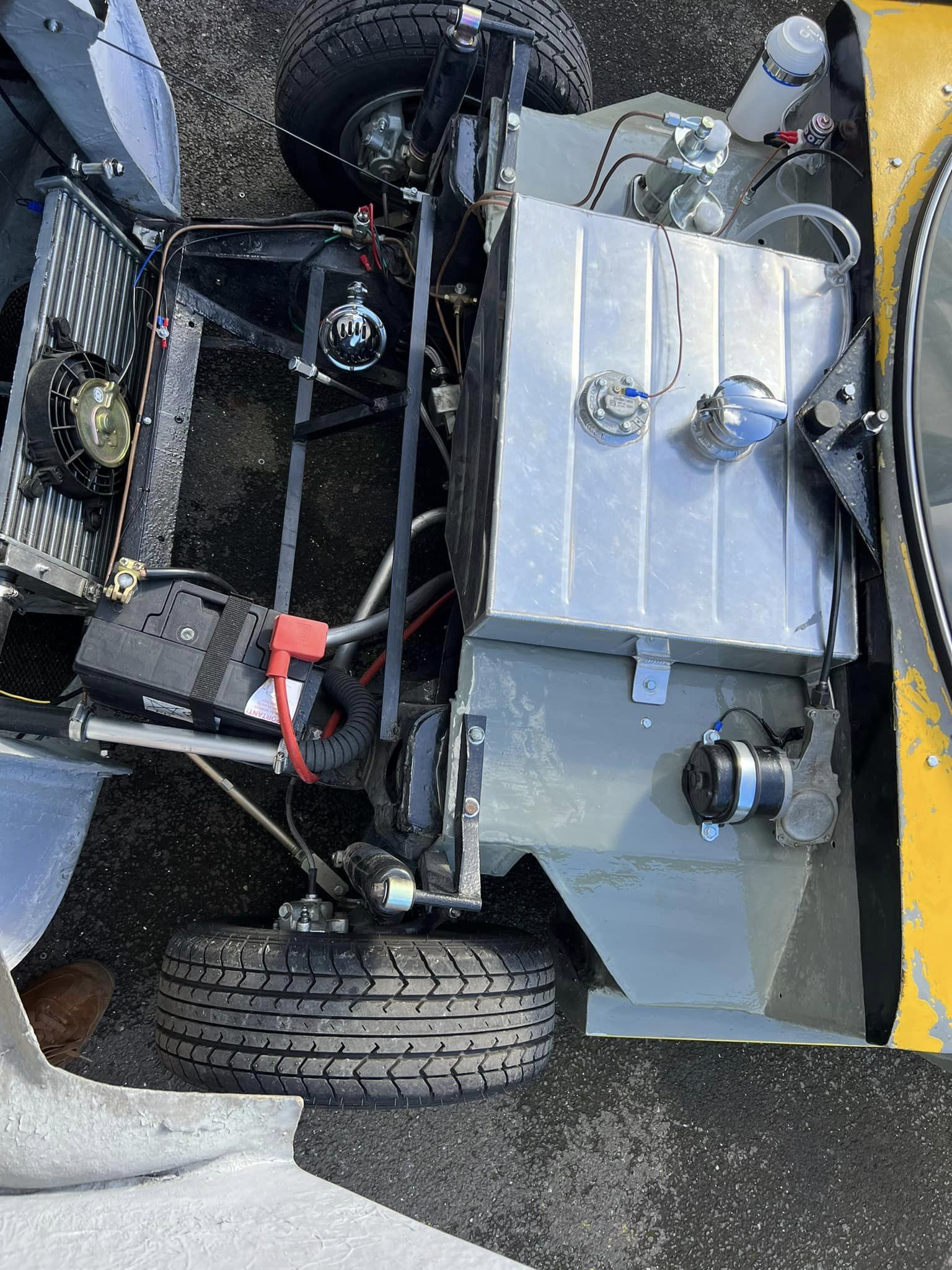
 Alloy 3 core radiator, baffled custom alloy fuel tank, fully rebuilt suspension and much more
Picture Andy Parkinson

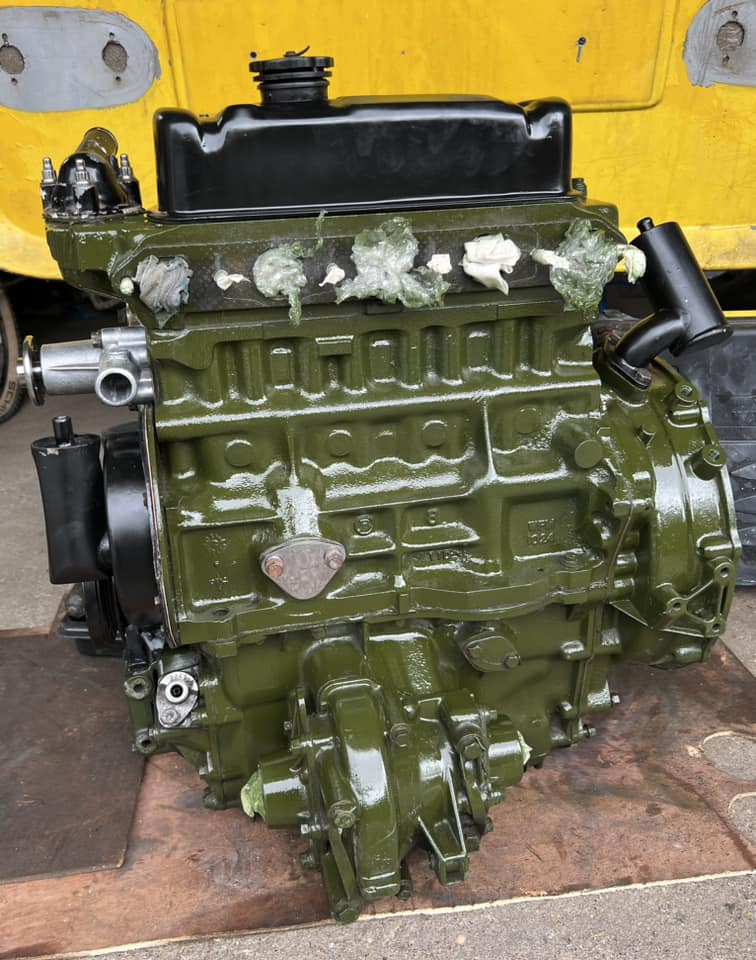
1275 A+ engine before it went in, with MG Metro cam, big valve cylinder head, 1.5” rockers etc...
Picture Andy Parkinson

And a walkaround video to give an even better impression about it...
Video Andy Parkinson

...Plus one of the engine running
Video Andy Parkinson

Thursday, 17 June 2021

Mystery Mini derivative (77)

This agricultural oddity has turned up for sale in North-Wales. It looks to be a cross between a Scamp and an RTV but I guess it has no links with these. Remarkably, it does use both the Mini subframes, with the standard dry suspension and comes with a 998 engine simply driving the front wheels. It does look ever so rugged and strong with its chassis from square tubing and those big Terra tyres. The seller writes: "I am told that a great number of Minis have been converted in the past when they were particularly cheap to buy and run, to be used on golf courses, farms and construction sites till more modern machines have been developed."

Indeed, this one could well have been made with on of these ideas in mind. Who knows more? The ad can be found here.


Tractor? Mini harvester? Crop sprayer? Airport vehicle? Golf cart? I don't know!
Picture Ebay

It looks like a cross between a Scamp and an RTV, both by Robert Mandry...
Picture Ebay

No 4WD though. It uses all of the Mini suspension, both at the front as at the rear
Picture Ebay

Engine is a 998 and it seems that the builder liked BMC's green paint colour!
Picture Ebay

Monday, 3 August 2020

The Prisoner Moke can now be yours

To get in the mood for this message, may I recommend you to watch this first? Yes boys and girls, that's the opening theme to that great 1960s series 'The Prisoner'. This series had such an impact that the very confusing ending led to troubles. The late Patrick McGoohan, who played the lead, said later: "The switchboard at ATV was jammed overnight, my children were molested coming from school and people were beating on the door with malice. We had to go to Wales for a couple of weeks with no telephones or contacts or whatsoever to the outside world." When fiction becomes fact... 

But apart from McGoohan the stars of the show were perhaps the village of Portmeirion in Wales and a couple of converted Mini Mokes. Just one of the Mokes was believed to survive until one time warp car was found back in 2011, which turned out to be the original and first one, too (unfortunately not by me but in my home country! - click here). It ended up in the possession of Phil Caunt who beautifully restored it. When it was finished the car was fully featured in MiniWorld and Classic & Sports Car magazine in 2018 and still is in an immaculate condition. Phil, however, hasn't been getting any better himself and has now decided to sell it. He wrote: "I wouldn't be selling but my health is not good. It is with a heavy heart that I have now, after 5 years of ownership, decided to sell the car."

Here's the outline that he wrote. 'The Prisoner Moke' is HLT 709C, the fully restored original Mini Moke as seen in several episodes of the series, and once showing its true registration number in the episode 'Living in Harmony'. McGoohan himself drove it in the famous chase scene on the beach in Portmerion. Indeed, it appears in most ' Portmeirion' episodes as well as the later studio based ones, finally appearing at the famous press launch at MGM Studio's at Borehamwood. Built in May 1965, and registered in June in London, the car was converted by Wood & Pickett to a design which resembled a 'beach buggy'. It is unknown who commissioned the car but the company 'Weircrest' were to market it... It was used in brochures, photo-shoots and publicity material, and by the London Hilton Hotel. One has to assume it was spotted by a member of the production crew as what they needed for the upcoming TV show 'The Prisoner'. Based on this another three Mokes were converted to resemble this one, including CFC 916C, which was owned by Max Hora the owner of the Prisoner shop in the 1980s and 1990s. Indeed I owned and restored this Moke back in the 1990's, this vehicle now resides in Los Angeles with a Prisoner fan and Moke enthusiast.

HLT 709C was taken down to Portmeirion in late 1966 to begin filming, closely followed by the other three. Whilst filming it sustained damage to the front and had to be returned to London for repairs, the other Mokes covered its absence. After its fame in The Prisoner the car disappeared and its whereabouts were unknown, it appears to have spent time in the Sheffield area in the 1970's but after that the trail goes cold. It is rumoured to have been owned by a member of the production company although I have not been able to confirm this. In 2011 it was discovered in a farm building in Holland by a Mini enthusiast, still with its UK number plates, 'candy stripe roof' and Penny Farthing bonnet logo intact but obviously worse for wear. On to 2015 and the owner decides to sell and the car goes to auction. Upon taking delivery of the car ( I did not view it before buying... sometimes you just know you want it!), I assessed what was needed for a full but sympathetic restoration, keeping everything I could to keep the car as original as possible, whilst obtaining anything else to bring it back to how it looked in 1966. 

Perhaps the most famous of all Mini Mokes - converted by Wood & Pickett in 1965
Picture courtesy Phil Caunt

The car was used by Patrick McGoohan in the television series The Prisoner back in 1966
A famous scene reenacted for this picture on the beach of Portmeirion, Wales
Picture courtesy Phil Caunt
Monday, 27 March 2017

Autocrossing an early Mini Jem (3)

And the messages regarding the Mk1 Mini Jem that was auto crossed in the late 1970s and early 1980s continue to come in! (See here for part 1 and part 2). This time the news comes from the Hawkins family themselves, who auto crossed it. John Hawkins wrote: "Hi Jeroen. Great to see your articles. Here's our part. Jeff Hawkins was a local clubman driver from Neath, South Wales. He crossed over from road rallying to autocross which was popular in the 1970s to mid 1980s. He was employed at Cam Gears/TRW at Resolven and they sponsored the car. The Jem was bought for £150 via Motoring News as a basic rolling shell which had been used for autocross. It had a hand beaten basin for the drivers head to clear. It was featured in Rally Sport magazine quiz which asked 'What type of car is this?', complete with Cam paint colours."

"We developed the car by swapping all running gear from our Mini. 'S' front brakes, alloy rear back axle, full cage, which was our own design, with the top extended to top subframe mounts. This was to stop the windscreen moving, as pointed out by Ian, as the front pillar had internal damage. Engines ranged from 1,310 - 1,340 - 1297 to 1293. Jeff was a class E BTRDA champion front wheel drive over 1300 class. We also built our own Mk2 Mini Jem road car, which we purchased from London. This was registered 'AAR 8K', which we eventually sold in the 1970s in the Cardiff area (that raises another question!-JB). I have attached two photos but am in the process of digging out more. Thanks. John." Well, thank you John, for clearing up a bit more of a most intriguing autocross entry!

High flying Jem: Jeff Hawkins auto crossed the Mini Jem and had no fear in doing so!
Picture courtesy John Hawkins

Jeff Hawkins worked at Cam Gears/TRW and became BTRDA champion in the front wheel drive over 1300 class - Class E. Seen here with one of his trophies and the Mk1 Mini Jem
Picture courtesy John Hawkins

Friday, 27 May 2016

Whatever happened to JDB 260E?

One story leads to another, here on GTM-week. Richard Hawcroft wrote to me regarding yesterday's Cox GTM: "I think you are getting old Jeroen. The Japan red Cox - it's an early one. Flat back, one-piece engine cover, no door handles, early front. Don’t forget that the sills are longer on a Cox, so if you fit a Cox front to a later car you would either have to make the sills longer or mess with the front." Ahem. Well. He must be right!

But it also lead to a message from former Cox GTM oner John Thornburn. He dropped a line about his old car registered 'JDB 260E'. That number rung a bell and I found some nice old photographs in the files, with it being the aluminum bodied prototype, factory demonstrator, press car, plus the one raced by Howard Heerey. There's a brief spell of it in this 1967 video, too. Quite some history! John wrote: "I have written before in response to a request for info on early GTMs. In 1970 or '71 I purchased from a friend, son of a garage owner in North Wales, a yellow GTM, JDB 260 E, a most interesting piece of 'kit'. GTMs as well as other kit cars, being very much of a hands on pastime I soon became aware that although the front end was fiberglass while the rest of the car was aluminium. One issue I had with the car was that the hubs on the rear (front) subframe were held in place by the steering arms bolted to the subframe, okay when first done but very soon works loose resulting in variable tracking when taking the power off causing the car to snake at the rear for a moment, interesting at speed. I contacted Heerey Engineering, living about 6 miles from Midland Garage, to be advised that they had resolved the problem with, from memory, (this was when I was 19 and I'm now 64), a lower wishbone tapped into the hub at 2 points and fixed with bushes to the subframe. The reason for the preamble is that the may be if some use to someone. One of the Engineers made a comment that some part of the body where he was working near was aluminum to which I replied that with the exception of the bonnet it was all aluminum, only then to be told after he checked some more that it was the original aluminium body that that the moulds were taken from and the bonnet was damaged beyond repair in London when being driven to be exhibited at the Motor Show. No mention was made of other metal bodied GTMs."

Now that is most interesting. It leads to two questions: how about Nick Beaumont's part-aluminium bodied car? And also: whatever happened to JDB 260E?

That's it - JDB 260E was the aluminum bodied Cox GTM demonstrator and press car
Picture Jeroen Booij archive

It was also raced by Howard Heerey, seen here chased up by a Ginetta and a Tojeiro Jaguar I think
Picture courtesy Richard Heseltine

 Reader John Thornburn owned it and says only the front had been replaced by GRP
Picture courtesy Richard Heseltine

Another venue, but clearly the same car once more. Silverstone perhaps?
Picture Jeroen Booij archive

Ingham Engineering also used the car for advertising the Cox GTM. Where is it now?
Picture Jeroen Booij archive

Thursday, 11 February 2016

A Mini based eight- (8) wheeler!

Just when you think you've seen it all, someone drops in a line with something you'd never thought of before. Well, it happens to me every now and the line that Chaz Ing dropped this week was another eye opener. I know of many Mini based four-wheelers; I've seen quite a few Mini-based three-wheelers, there have been several Mini based six-wheelers and I even know about Mini based two-wheelers and Mini based tracked vehicles. But a Mini based eight-wheeler? Good grief, I did not know that existed.

But it does, and there is in fact one for sale in Powys, Wales, at the moment - see the ad here. It's an ATV Argocat, which I did know as a two-stroke twin cylinder powered contraption, offered for sale by Crayford Auto Development of Kent. Yep, they were the same company which converted Minis into convertibles since 1962. I don't know if this four-wheel steered 1000cc Mini automatic powered version comes from them, too, but I'd love to find out.

This ATV Argocat does use Mini power to drive eight wheels, two of them removed here
Picture courtesy Ebay.co.uk

The 1000 engine is placed longitudinally next to seat. How is it constructed to drive the wheels?
Picture courtesy Ebay.co.uk

This contraption appears to have nearly been buried in Wales until not too long ago. It's for sale now
Picture courtesy Ebay.co.uk

Crayford's Argocat sold strong in the 1970s, but did they ever build a Mini based version?
Picture Jeroen Booij archive

Friday, 20 June 2014

Barnfind Biotas and a long-forgotten Jem

Over two years ago I posted an article about the MiniJem estate that was supposedly factory-built. See here. Was there anyone out here who knew what happened to the car? Well, it took a while, but I have finally found out that it does still exist. Steve Padfield dropped me a line, saying: "I own the prototype Mini Jem Estate you have listed, that I bought from Mike Brown. It is still safe and I hope to restore it one day but as usual there are more projects than time. I plan to paint it light blue once I have tackled the crazed gel coat as I have an unfortunate history with motor vehicles painted white. The interior will be light grey. Knowing it is such a rare car I will be restoring it as far as possible to original specification. Retirement is in the near future so perhaps then."

Steve Padfield owns the MiniJem estate nowadays - seen here in 1993
Picture courtesy Jeroen Booij

Steve also wrote me that he has another nice project awaiting restoration: "I also have a Mk2 Biota that I rescued from a peacock farm in mid-Wales where it was being used as a roost. The upholstery suffered being buried under **** for so long. Another rescued project awaiting time…" Great stuff Steve, do not forget to send some pictures! As a matter of fact it's not the only Biota that has been recovered recently. Paul Wylde sent me some pictures of a Mk1 Biota that had been locked away for 30 years. Paul: "The guy was going to use it for parts until I told him some history about them!" Well done, mate. And keep us posted.

M-reg Biota Mk1 has been locked away for 30 years before being saved last week
Picture courtesy Paul Wylde

It's a Mk1 with the rarely seen triangular blinkers. Needs some work though!
 Picture courtesy Paul Wylde

Engine is of unknown capacity but SUs with nice trumpets may direct to power
Picture courtesy Paul Wylde

Wednesday, 1 May 2013

The Summer of '69... with a Caraboot

Remarkably, some of the best comments here come in from Australia. This one about a Bulanti was great, or how about the tale of Jack Kaines' Ecurie de Dez? Now, Doctor Rudy Rencoret of Sydney is next. He dropped me a line or two about a holiday he and his wife Sylvia undertook decades ago. He wrote: "In the Summer of 1969 we went around England and Scotland for about six weeks in my Caraboot. I rented it from a Mister Theobald in Preston, Lancs, who I might have found when I was looking for a caravan to pick up in Lancashire. This after I passed (successfully) my specialist medical degree in London. It was a marvellous holiday, starting in Windermere, on the Lake District, up to the Highlands of Scotland, down to the East side of England, then the Midlands, South of England, the West Country down to Land's End and up again on the West side this time, including Wales and finishing in Liverpool. We spend the boat a full day sailing on Coniston Water on the Lake District. The only inconvenience with the boat was that it was quite heavy, and so were the oars."

"It was only in Dorset when I was attempting a rather steep road beyond Portland that the little 850cc Mini engine decided that it was a bit too much and stalled. When I was going up that hill I started in 4th gear, then I had to engage 3rd, 2nd and finally, 1st gear, as the steep part of the road was too long. The poor old 850 cc engine stalled, and I could not go any further. I asked my wife to leave the car and with great difficulty I reversed it in that very narrow road. I could see a steep fall into the Channel on my reverse mirror and the little brakes were hot and unable to hold it. Had I reversed the other way I would have finished in the English Channel, Caraboot and all. But in the end we made it and continued with our trip. I may add that the engine temp never went above normal that afternoon. The Caraboot behaved splendidly, low on petrol and created a little sensation wherever we went. When we stopped for shopping in a small village and came back to the car we usually found it surrounded by people who wanted to know all about it. A number of people thought we were a bit mad, and so we were. But it was just wonderful." And so is the story, thanks again Rudy!

The Caraboot and a young Mrs. Rencoret, somewhere in the UK in the Summer of '69
Picture courtesy Rudy Rencoret

The Rencorets in the place where they spent much of June and July of that year: in the Caraboot
Picture courtesy Rudy Rencoret

Mini based camper was a joy to drive, says reader. Only trouble was to tackle a Dorset hill 
Picture courtesy Rudy Rencoret

Great holiday memories include cooking in the Caraboot's tiny kitchen
Picture courtesy Rudy Rencoret


Friday, 4 March 2011

Camber/Maya files: FNU400H


Blimey, this has become a bit of a special story that I only recently found out about. Take a big breathe if you are interested in this third part of the Camber/Maya files series, with special attention to the Camber GT with registration FNU400H. I have only been able to track down much of its history recently thanks to the car's last two owners and have found out that its a most unusual history too.

Log book for a most unusual Camber GT, or was it Nerus GT?
Picture Jeroen Booij archive

Where to start? Well, logically that would be on 20 October 1969 when the car was registered. But it now appears that this wasn't the first time the car was registered. In fact, I am sure it is the same car that I described last time: DEN70D. So what could have been the reason for that? Well, as you may remember DEN70D, with its modified head lights, was shown at the Racing Car Show in January 1967 at the stand of Camber distributer 'Checkpoint Race & Rally Equipment Ltd.' that had also become the owner of Hastings based Nerus Engineering: a tuner that specialized in Minis. And what better way to promote your engineering company than with your own sports car? Yep, they turned the Camber GT into the Nerus GT by just re-registering it and putting another badge on its bonnet. Nerus also happened to be involved into the development of a Silhouette type race car which used the same badge. All easy! 

All the badges that have graced the cars: Camber, Nerus and Maya
Pictures Jeroen Booij archive


According to the log book Checkpoint's sold the car to somebody in Prestbury, Cheshire, bought it back in september 1970 to sell it again to Bangor, North Wales. More owners followed: a garage in Aylesbury and a man in Ardley, Bicester. But it wasn't until 1988 that Simon Mogford spotted it in an advertisement and went to collect it in Oxford. The reason for Simon's interest was a good one too: his father was sub-contracted in 1966-1967 to build the Camber and Maya GT for George Holmes! Simon says: "My dad has his own engineering company down in Hastings back then and this project was just work that came along. He produced the whole car. and I remember him redesigning the head lights too. I also remember going with him to Brightom to get screws for the car's dashboards."

The Camber GT (or Nerus GT - note Nerus badge) as bought by Simon in 1988
Picture Jeroen Booij archive

Head lights make clear it can only be the show car. Note flared arches
Picture Jeroen Booij archive

Remarkably Simon's father Kenneth Mogford recognized the car as the one on the Racing Car Show stand. And even more remarkable: albeit without its Nerus tuned engine Simon bought the car with all the moulds, including that for the Camber-, as for the Maya nose section too! Simon continues: "When we moved to the isle of Man I took the car with me in 1992. My dad and I reckoned that at the time, with all the interest from Japan in the Mini Marcos, there could be a market for them and we figured that we could sell new bodies at 850 GBP. But unfortunately we never had the finances to do it. When I moved back to Hampshire I took the car and all the moulds with me and decided to sell it as I never got round to restore the car."

The original builder Kenneth Mogford planned a revival for the Camber GT!
Picture Jeroen Booij archive

And this is where the last owner, Mini enthusiast Andy Clayton, comes in. Andy bought the Nerus registered Camber GT in 1998 with the idea to restore it to its former glory. But as he was also in the process of buying a house back then he decided the car project had to wait for a while and Andy parked it on a site in Bramley where dozens of club members of the Mini Cooper Register kept their cars too. But this is where disaster struck in July 2003. Andy: "There was a massive fire destroying most of the Minis and my car too. The sites around it where developed for housing and it is suspected that somebody put fire to the building to get rid of the Minis and be able to start building there, too." Soon after the fire the site was cleared and Andy believed that the moulds where destroyed too. It later appeared this was not the case but remains unsure if they survive to this day. Andy: "They could have been thrown in a skip." Simon Mogford heard of the fire too and went to have a look but did not find any evidence of the moulds surviving. And that's where the unusual story of FNU400H ends. Funnily 'Nerus Engineering and Co Ltd.' is still in business in Worthing, but while they specialize in motor bodies they have nothing to do with the old company apart from the name that they have taken over. It really ends here and unfortunately this story won't be continued.


On the Bramley site in a sorry state. Original silver grey was under orange paint
Picture Jeroen Booij archive

As the interior shows there was plenty of work to do there, too
Picture Jeroen Booij archive

Ouch! And this is what is left of the Camber GT after the fire. What a shame
Picture Jeroen Booij archive