Showing posts with label DART. Show all posts

Tuesday, 9 April 2024

Now in Maximum Mini Newsletter #19


Biota importer re-imports yet another Biota

Mystery Mini derivative (87) - Autotest Special


Readers: where are they from and what do they own?
From DART to Kingfisher, Tricar to Landar

Wednesday, 10 January 2024

Now in Maximum Mini Newsletter #6:


A photographic look at the DART's launch in January 1964

Richard Oakes and the 1977 Midas prototype 

Warwick Mk2 racer - a Mini derivative..?

Yes, that does look very much like a Mini engine ...but...

Thursday, 7 September 2023

The many faces of a wild custom Mini of the 1970s

After two recent articles, here on Maximum Mini, reader David Kiss decided to drop me a line. The reason was that two of the cars described brought back some sweet memories. David wrote: 
"Dear Jeroen, Not sure if you would be interested but I have been inspired to write following two of your recent blogs about custom Minis. In brief, I was given a 1961 Mini on my 17th birthday (1971), I kept this car for 12 years over which time it morphed from a humble 850cc into a 1750cc (Maxi/Allegro) powered custom, similar custom De Ville type build to the recent pics of '50 MAR'. (click here for the recent article about that)"

"I sold the car in 1983 as it was unsuitable for my new married life....(it may still be out there?) Re DART: my (late) dad was also in the RAF and Dizzy Addicott was a pal of his, I remember my (late) mum saying "He was a real speed freak". I'm sure I met him many years ago as a young boy but have no real recollection of him (recent article here). If my 1750cc Mini is of interest I do have quite a few pictures of it during my ownership. Keep up your great blog. Regards, David Kiss" 

Well, I did like that, and asked David for the pictures he mentioned. The next day I received a whole lot of them, with clear descriptions, too. David added: "I'll attach a set of pictures of the car over my ownership showing the various stages of its 'development'. I'm not sure how much detail you wanted me to go into but I'll waffle away and you can pick and choose as you like should you wish..... As I mentioned, I was given the car for my 17th birthday (1971), a 1961 bog standard cherry red 850cc Morris Mini Minor in pretty sound condition. My Dad and his brother-in-law ran a local Morris garage and the car was a 'trade-in'. With my Dad running a garage I had been interested and driving (in a field) cars since I was 11 years old. I used the car daily, generally flat out like all seventeen year olds... The poor old thing soon expired and with the desire to go faster I replaced the engine with one from a BMC 1100..."

"On recently checking the 240TPG on the DVLA system I see that the last change of owner was in 2007 so one never knows if it's still out there... as many others I would quite like to see if it's still about, perhaps even owning it again... curiously I now own another 1961 Cherry Red Mini, however, very standard, very original! Well I hope I've not rattled on to much, Best regards, David."

It's just lovely David. Thank you very much!


"This picture shows the car with the 1100 engine fitted. Note the 12" wheels as per BMC 1100 and also other go-faster mods!"
Picture courtesy David Kiss

"A bit later and now repainted (very dark brown) plus flame motif. Paint work was courtesy of the firm I worked for at the time, we repaired all the new Toyotas that were damaged in transit, they were all imported back then, 1973-ish"
Picture courtesy David Kiss

"The company had a low-bake oven system and the flames were designed and painted by one of the very talented staff. The car had also acquired a BMC 1300 by then and was relatively now quite a fast machine. The 1300 worked well for some time but I eventually wore it out so what next..."
Picture courtesy David Kiss

"This picture shows a Maxi 1500 engine basically installed. I had to cut and extend the front of the subframe to fit the larger engine and subsequently modify the front of the car. Many other items had to be fabricated, driveshafts, engine mounts etc. It was quite an awkward job but I was able to use the facility of dad's garage (and his help), which got the project completed. Note the DAF's: the garage had lost it's BMC dealership and was now a DAF agent!"
Picture courtesy David Kiss

The 1500cc car with David as its builder and proud owner in the mid-1970s. Note Jaguar leaper
Picture courtesy David Kiss

"The grille is from a Vauxhall VX4/90. The bonnet was held in place with four large dome-headed bolts and had to be removed completely for access to the engine"
Picture courtesy David Kiss

Much-modified and fast, but not enough for David at the time. There was more to follow! 
Picture courtesy David Kiss

 "Here the car is seen with another modified Mini that I came across (1975). I can't recall what mods it had. Shortly after this picture was taken my modified front subframe failed, so back to the drawing board. I then decided that more radical changes should be carried out..."
Picture courtesy David Kiss

"Bodywork mods, shortened rear side windows, de-seamed, small rear window etc etc... I had some wheel discs made as there was very little choice of alloys wheels that suited, but I didn't proceed with these. Note the hardboard template on the bonnet, this was used to make up a veneered dash, (Mk2 Jag) instruments were fitted behind smoked glass panels, illuminated when the ignition was switched on. An old friend was an excellent woodworker and made me up the dash to an exceptionally high standard (as good as a Rolls), sadly I never took any pictures of this. I had considered Merc headlamps but again this did not materialize"
Picture courtesy David Kiss

"Now painted and complete with two tone vinyl roof... all the rage at the time. The engine, waiting to be fitted is a tuned 1750cc Allegro SS, note that the subframe is standard so as not to suffer the same issue when fitted with the 1500cc engine. It was the oil filter that was problem but this latest incarnation has a remote system as can be seen. The car still has an extended nose to house the radiator etc... I had also modified the bonnet and it now hinged forwards"
Picture courtesy David Kiss

This shows the modified bodywork in its full glory
Picture courtesy David Kiss

"This is when I put it up for sale due to getting married and not being a suitable family car. With the 1750 cc engine it was quite a thing to drive, it had lost the nimbleness of the original Mini but was mighty fast, with its 5-speed gearbox it would cruise at 90mph and was capable of 120mph+ Of course today there are many easier engine conversions with the abundance of front wheel drive cars but back then this was limited more or less to BMC/BL cars... the only other engine that may have been a candidate back then was the V6 Ferrari Dino engine..! out of my price league though"
Picture courtesy David Kiss

Friday, 25 August 2023

Tracing the DART's origins (2)

Following the earlier contact I had with Nigel Fraser Ker (click here), Nigel became very curious about where exactly the workshop could have been, where Edmond 'Dizzy' Addicott built his DART. I had one old picture of the outside of the premises, showing just a part of it plus a sign for a company named 'Wakefield & Sons'. After a while Nigel came back to me about it: "Crikey!" he wrote, after he'd found reference to Wakefield & Sons in an online issue of ‘Byfleet Heritage’. What's more: there was further reference to the place: "We began our tour at Parvis Bridge where the boathouse still looks pretty much the same. To the right of the bridge were Wakefield & Sons who made Formula 3 racing cars. After passing the cricket club and Mr Derisley’s highland cattle you came to the War Memorial..." etc.

Nigel: "Parvis Bridge is right next to where BAC was based and where Dizzy worked, and only 11 miles from where I am now. Incidentally, when I used to work at the Brabham F1 team, some of the fabricators had worked at Brooklands. Many of the skills used in building aircraft during the Second World War were the same as those needed to build racing cars prior to carbonfibre becoming the favoured material. What appears to be an aluminium-bodied car that you can see in the photographs (it is in fact steel-bodied - JB) would almost certainly have needed a very skilled craftsman to make - I don't think even Dizzy could have done that one! A job for people working up the road at Brooklands, I'm sure. These buildings look like they are old enough to the place in the photo. I wonder if they are the same? Perhaps I can pay them a visit - it would be great fun locate the site of Dizzy's garage!"

Another day passed. Then: "Dear Jeroen, I have found it! The building is a mile or two further to the west than I believed, but the good news is that it is still there. I will visit it as soon as I can and find out what the current occupiers know about its history."

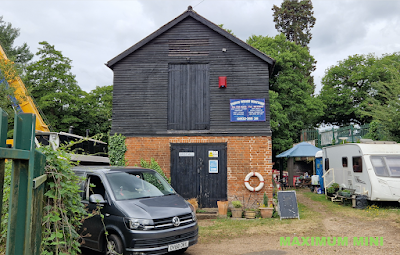
And yet another day went by. "Hi Jeroen, I'm happy to say that I have now visited the workshop in Byfleet and have walked through the door shown in the photograph! This is what I found out... The building is actually associated with the canal that it is next to - the canal was built in 1653 and the building has been in existence since at least 1760. It was originally single-storey, but had the additional floor added some time later. There is a 19th century building/shed next to it and in the 20th century this had been used by an engineering company but the people who run the canal boat business at the wharf (Stuart and Julia) don't know anything about them. The couple arrived 20 years ago and when they got it the buildings had been empty for at least 10 years, and had been previously occupied by a company which made exhibition stands. Some time before them, it had been owned by Wakefield & Sons, but they had moved to West Byfleet. Stuart remembers that his father used to bring his car to Wakefield & Sons to work on. Stuart and Julia don't know anything about the motor racing or Mini Marcos history of the building, although over the years several people have visited them and said that they remembered the car workshop on the site, which is now all owned by the National Trust, including the canal."

"Two points to note: They were interested that the upper outer walls (which are now wooden and dark coloured) are white in your photographs. They don't know how that happened. Was it external cladding? I wondered if the upper wood is new. They are positive that the pictures of Dizzy working in an office are definitely not taken in that building - there are no windows of that style there. Stuart has heard that before WW2 the site had been used by ERA, and that they would take the cars to Brooklands for testing. However, I can find no verification about this, but I might see if there is an archivist at Brooklands museum who can help. That's about all I found out. Please feel free to use the attached photographs and any of the above as you wish. Stuart and Julia were amazingly helpful and spent about an hour with me, talking about the history of the site. They were fascinated to see your pictures. I hope this is of some small background interest to the whole Mini Marcos history. Regards, Nigel"

I absolutely love it!
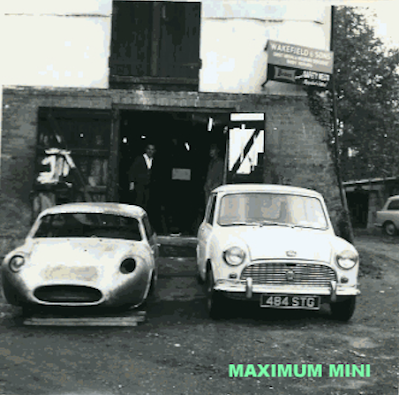

Dizzy Addicott's workshop in 1963. The 'Wakefield & Sons' sign was the clue to its whereabouts
Picture Jeroen Booij archive

The same workshop in Byfleet, Surrey, 60 years later in 2023. Not much has changed!
Picture Nigel Fraser Ker

The building, now owned by the National Trust, exists since at least 1760 and is now a boat wharf
Picture Nigel Fraser Ker

"The current owners don't know anything about the motor racing or Mini Marcos history of the building, but over the years several people have said that they remembered the car workshop"
Picture Nigel Fraser Ker

Excuse me, I simply could not resist doing this...
Picture editing Jeroen Booij

Wednesday, 23 August 2023

Tracing the DART's origins (1)

I was contacted by Nigel Fraser Ker a little while ago, and while things started out chatting about the Mini Marcos, we were soon directed towards the Marcos' origins: the DART as it was designed and built by Desmond 'Dizzy' Addicott. Nigel happened to know quite a lot more about Dizzy and an intriguing correspondence followed. Over to him:

"I would be happy to tell you a little bit more about Dizzy - at least the part that I know from personal experience. My father was a pilot, first of all with the Royal Air Force and then he got a job with De Havilland as a test pilot. They were keen to hire him because he managed to save an aircraft which was of a type which had been causing many deaths due to unexpected engine failures. He had one himself over the North Sea and managed to save it by gliding it into Schiphol airport. This meant that De Havilland were able to inspect it and find the fault. This was back in about 1956 and I think it was when he first met Dizzy who was himself a test pilot. In fact I think he was one of Britain's most experienced - he had flown very many different types of aircraft (I remember he once flew a Catalina back from South Africa as a delivery). My father moved into flying jets for commercial airlines and briefly had a job in South Africa so we all went with him."

"The job didn't work out so Dizzy managed to get him a job working at the British Aircraft Corporation, based in Weybridge (Surrey) and flying out of a nearby airfield called Wisley. I remember going there as a child and seeing them testing the BAC One-Eleven. Dizzy was a real character - very much old school and great fun and he visited us many times at our home in Bookham, Surrey. Incidentally, my father used to share an office at the Weybridge factory with Sir Barnes Wallace - I don't know if you've heard of him but he is the guy who designed the famous bouncing bomb which was used against the Germans in the raid against the dams. Anyway my father (who was a bit of a troublemaker like Dizzy) said that both he and Barnes, who was making a nuisance of himself by saying that Concorde would never be commercially successful, were put into an office together away from other people so they wouldn't cause any trouble!"

"When I was 17 my father persuaded me to buy a Mini Marcos kit. Unfortunately, I became so involved in motor racing (I used to work for Bernie Ecclestone at the Brabham F1 team in Chessington and then drove mainly rally cars) that I never got around to building it and so I sold it again, but I have always felt an affection for the design, tinged with a little guilt at not completing it! Anyway, the Weybridge BAC factory (which was located at the Brooklands racetrack) was mainly converted into an industrial estate, but with a museum to commemorate the racing and aircraft work that used to be carried out on the site. Accordingly, I decided to take the children along to see it. You will imagine my surprise when one of the racing cars on display had Dizzy's name written down the side of it! With such an unusual name it must have been the same man, so I did a little research and found out about his interest in cars and also that he had designed the Mini Marcos. At this point it all fell into place - I realized that the reason that my father had recommended the car to me was because it had been designed by his friend. Perhaps I knew this at the time, but I had certainly forgotten. 

Anyway, I'm sorry to say that Dizzy (along with my father) are now dead. Dizzy died on the A11 road heading towards Norwich. It was a stroke and I believe that he knew nothing about it. He really was an extraordinary character - someone should write a book about him, if they haven't already! When I decided that I was not fast enough to make sensible money out of motor racing I decided to get a proper job, so I settled down and started my own family with my wife Fenella. Now, my daughter Kate is 22 and the two of us are competing in the Mini 7 Championship (really to give her a chance to learn about motorsport). She is really enjoying it so we have been trying to decide what to race next year, and when I was searching around the forums, I found out about your car and was naturally excited to learn more about it."

Well, that was more than I expected!
But it wasn't even all. When I showed some historical photographs I had of Dizzy and his workshop, the detective in Nigel was awakened and a fascinating search followed. You'll read all about the result later this week. 

UPDATE 25 August 2023: in part 2 we find back the actual premises where Dizzy built his DART. Click here


The unique and fully rebuilt DART at Goodwood back in 2010
Picture Jeroen Booij archive

This rare picture shows the car being built in the winter of 1963
Picture Jeroen Booij archive

"Dizzy was a real character - very much old school and great fun and he visited us many times"
Picture Jeroen Booij archive

The DART shortly after being unveiled at Paul Emery's stand at the 1964 Racing Car Show
Picture Jeroen Booij archive

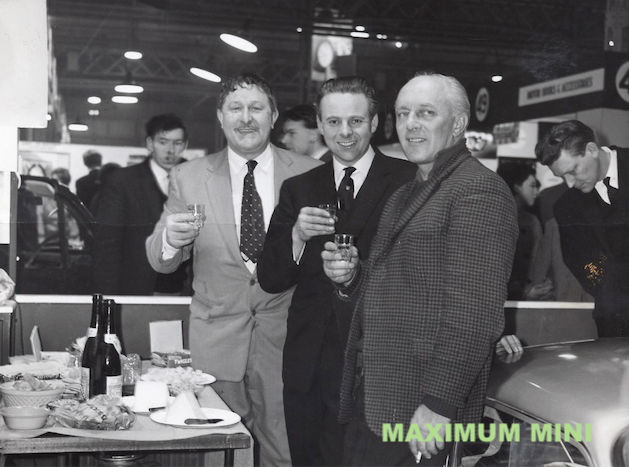
Racing Car Show '64 again. Left to right: Paul Emery, Jim Clark? (I think) and Dizzy Addicott
UPDATE: Believed not to be Clark, but who is it then?
Picture via Giles Chapman

Monday, 19 October 2020

Mystery Mini derivative (70)

A little ad from a 1974 Cars & Car Conversions magazine was sent over by Rachel Nelson, who wondered if I knew it. I don't. The car is advertised as 'Mini based Special - one of three only' but I have never come across anything similar or it must be the DART, which has perhaps some hints of this creature. The ad further states '41 inches low, less engine and box. Must go now, getting tatty so best offer secures', followed by an old London number. I can't read the registration well ('GBP 801C' perhaps?), but maybe it rings a bell to anyone here?


Mystery Mini derivative from London as seen in a 1974 ad and said to be 'one of three'
Picture Cars & Car Conversions via Rachel Nelson

DART has perhaps hints of it, but can't have anything to do with it, can it?
Picture Jeroen Booij

Friday, 3 April 2020

Jeremy Delmar-Morgan passed away at 77

It's with great sadness that I found out about the death of Jeremy Delmar-Morgan. Only now, as he passed away on 12 June 2018 at the age of 77 already. That's almost two years ago, but I thought the man definitely deserved an obituary here despite the time lapse. Unfortunately I never had the chance to meet him in person.

Delmar-Morgan was born in a gentry family in London and got in touch with Hillman Imp tuner Paul Emery in his early 20s. It was under Emery's flag that he entered his first race in 1964: the Nürburgring 500 Kilometres in September that year and behind the wheel of an Imp. From that moment on a real taste for racing was developed and Delmar-Morgan showed up at a wide variety of tracks with Emery tuned Imps, a Lotus 23, a Brabham BT8 and even several Divas for the works team.

It was in Emery's London workshop, though, that Delmar-Morgan first learned about the DART of Dizzy Addicott. Emery had given a hand in the car's build and Delmar-Morgan liked the idea of a much streamlined Mini for racing. The car was eventually launched on the Racing Car Show of January 1964 at the Emery stand. When Delmar-Morgan found out that Addicott had enough of the DART project in a premature state, he took it over it for 750 pounds and turned the car into the Mini Jem. Meanwhile, Jem Marsh did a similar thing in launching the Mini Marcos...

Delmar-Morgan set up Jem Developments Ltd. and started a racing campaign with his Mini Jem, the first race once again being the Nürburgring 500 Kilometres of September 1966. He came home at a very respectful 18th overall and 2nd in class. Delmar-Morgan built and sold over 20 cars from his workshop in West London. In November 1966 he moved to Penn Garage in High Wycombe where Robin Statham rented him premises. Delmar-Morgan saw it as a temporarily solution as he had plans to move to a new factory close to Silverstone but these plans were never realised. He delivered another 12 body shells from Penn Garage, but then had enough of it. Delmar-Morgan then sold the Mini Jem project to Statham (obituary here) halfway in 1967.

He continued to race up until 1969, mostly in a privately entered Porsche 906. After that he focused on a career in investments. He married twice and had four children.


Jeremy Delmar-Morgan was the man behind the Mini Jem
Picture Braveheart Investment Group

He was friends with Paul Emery who had a hand in the development of the DART...
Picture Jeroen Booij archive

...And from the DART came the Jem - first production car seen here with works van behind
Picture Jeroen Booij archive

Delmar-Morgan raced a Mini Jem with some success. Here seen at the Nurburgring in 1966
Picture Jeroen Booij archive

After that he was mostly seen behind the wheel of his Porsche 906 - here at Brands Hatch
Picture zuff.be

Friday, 15 July 2016

DART at Chateau Impney

These photographs of the DART were taken last weekend at the Chateau Impney hill climb in Droitwich, where it was entered in the production saloon cars class! Last year saw the revival of the event with some 200 competitors to take the course over the two day event. The photos are kindly provided by Armando Loni. Thanks mate!


Friday, 14 September 2012

DART goes hillclimbing

Ever since Stefan Wray bought the remains of the DART and painstakingly reproduced the car in its former splendor, he wanted to race it. I managed to squeeze the just finished car into my book, and a couple of months later, At Goodwood's Revival, Nick Swift steered it to a podium place. Only now Stef took the wheel himself. He wrote: "Hello Jeroen, just a quick one. I've finally managed to hillclimb the DART. Its far too high geared for hillclimbing at the moment and my driving is very rusty but it's still a lot of fun. I'm waiting to hear from a chap I spoke to and who used to live next door but one to Dizzy Addicott. He thinks he might have some old photos of it! I'll keep you informed. Cheers, Stef" And so the file on the car's history continues to grow. Last year some lovely old pictures of the build were found. The pictures below are kindly provided by Dave Giulliatt. Thanks chaps!

Up-up-up. The DART is hillclimbed for the first time by its current owner 
Picture: Dave Giulliatt 
It's too high geared for hillclimbing, says Wray, but he still had lots of fun
Picture: Dave Giulliatt 
Astons look like lorries compared to tiny DART - forebear to both Jem as Marcos
Picture: Dave Giulliatt 

Wednesday, 29 June 2011

Unique DART pictures found

Thanks to Stef Wray, who rebuilt the one-off Mini based DART (for Dizzy Addicott Racing Team), some unique pictures that show the DART being built, have been unearthed from the collection of Desmond 'Dizzy' Addicott's family. Fighter pilot Addicott built the car in 1963 as a prototype to market fibreglass monocoque shells that could turn an old Mini into something far more sporty. Jem Marsh was contracted to do the shells, but when Addicott had a disagreement with Marsh over the quality of the first few fibreglass bodies he got so fed up with it that he sold the project to Jeremy Delmar-Morgan who turned it into the MiniJem in 1966. By that time Jem Marsh had allready launched his own take on the DART: the Mini Marcos. That means the DART is the spiritual father of both the Mini Jem as the Mini Marcos, as well as the Kingfisher Sprint that evolved from the Jem later.
Stef has been researching the DART ever since he bought the remains in 2008 but never knew pictures of the actual building existed. "I love them!" he writes. So do I.

UPDATE 25 August 2023. Original premises of Dizzy Addicott's workshop found! Click here.


The famous DART under construction in Addicott's workshop in 1963
Picture courtesy Jane Addicott-Jones


 Addicott preferred aluminium but the Morris Mini van based body is all steel
Picture courtesy Jane Addicott-Jones


DART was turned into Mini Jem when Addicott got fed up with the project...
Picture courtesy Jane Addicott-Jones


...while mould maker Jem Marsh developed the Mini Marcos from this base
Picture courtesy Jane Addicott-Jones


MiniSprint avant la lettre: the finished DART body next to an Austin Seven
Picture courtesy Jane Addicott-Jones