Tuesday, 21 June 2011

New derivative is a cross breed

It's not every day that a brand new Mini derivative is offered for sale, so when that does happen it surely deserves attention here. Well, there we go. This, ladies and gentlemen, is the Sprint GT by ABS Motorsport of Market Rasen. No, it's not a resurrected MiniSprint and neither a reborn Broadspeed GT. According to ABS "This Sprint GT GRP bodyshell is a sleek interpretation based on a mix of the MiniSprints and the Broadspeed GTs from the 1960's and 70's."
But you'd be foulish not to spot the real basis used for the new Sprint GT: it is the Peel Viking Minisport as designed by Peel Engineering on the Isle of Man in the mid 1960s. ABS started offering repro Viking shells some time ago, but very few were made. Perhaps it could do better with a new nose and a new name? The original Peel Viking Minisport's front section was swapped for that of a Minus Mini (not a MiniSprint), and there you have the basis for a Sprint GT. 

The GRP shell is bonded and laminated at the seams and has reinforcement around the subrame and component mounts. For 3,995 pounds you can buy one with doors (they are shorter than the standard Mini's doors), but it comes without a roll cage, which ABS advise you to fit. Click here to order yours.
Personally, I would prefer a repro Peel Viking MiniSport over a ABS Sprint GT, and in fact ABS is not the only company selling that. Andrew Carter of Nottingham, who took over the original Manx moulds in 2002 can build you one, too, for 3,685 pounds. Click here for more. What would you do?

A repro Peel Viking Minisport shell (left) is turned into the ABS Motorsport Sprint GT (right)

Original Peel Viking nose (left) is swapped for that of a repro Minus Mini (right) to form Sprint GT 

Monday, 20 June 2011

The tale of 'Bull Ant' the Bulanti

Over to Australia, from where news from one of only three built Bulantis has come to the light. Thanks to Kevin Boole, who read my request for information here, and sent in a great story and wonderful pics to tell me that the third car was registered 'CMI-495' and sold new to his friend Graham Jones, who sadly passed away in 2002. According to Kevin, who acted as a passenger regularly, the bright green Bulanti was a rather frightening machine despite its tiny size. This is the great story that he wrote, illustrated with some of the pictures he sent:

"Graham first came across Brain Rawlings and his garage at the entrance to Amaroo Park Raceway in 1970, a motor race track in the suburbs, north-west of Sydney, NSW, Australia. We were all mini owners, having just left school and now earning money. We had a variety of Mini models ranging from a Mini 850 sedan and panel van, Moke, 997 Mini Cooper, 998 Mini deluxe and 1275 Cooper S models filling the garages and street. We were intrigued by the Clubman's that Brian was building and one time we stopped to look at a new Chocolate car which he called a Bulanti. This car was registered BAL-551 for road use and based on the Mini. This one was also raced, setting quite quick lap times around the 1 minute mark at Amaroo Park."

'BAL 551', the aluminium bodied Bulanti prototype was used on both road and track

"I do believe that this car eventually was damaged in an accident, but most likely would have been repaired. One of our associates Graham Jones decided from the outset that he would like to buy one of these cars and so set in place the process to buy one. Graham had only recently purchased an ex NSW Police highway patrol Mini Cooper S, which was always the fastest of all our street cars. But Graham, not satisfied, always wanted to go faster. The Bulanti was the vehicle for that. He traded his Cooper S plus extra money to become the proud owner of one 'Kermit Green' Bulanti which was given the name Bull Ant or The Frog because of its bright green and frog like appearance. I can’t remember if Graham was given a choice of colours as the third Bulanti was bright red. The colour for these two cars was inside the fibreglass gel coat, as opposed to the first aluminium car that was painted."

Graham Jones's bright green Bulanti became known as 'Bull Ant' or 'The Frog' 

That's Graham with his then-new Bulanti to give an impression of the car's size 

"You will note in some photos the Bulant Motors Logo that was place on the vehicles on the nose, steering wheel and wheel centres. This was Brian’s logo that was on his business and work van which is also in one photo. Graham’s garage was large enough for 3 to 4 cars and the Bulanti took pride of place, with his parent’s car often relegated to the street. Over many nights and weekend the car was fitted out with its mechanicals and things to make it worthy of registration. Much unregistered testing on the roads occurred on those late nights."

Graham discussing the car at Brian Rawlings'. Note superb Bulant Motors works van in background

"The only failing of the car was that Graham always wanted something more powerful than anybody else. The motor was bored out from 1275 to 1310 with dynamic balanced components and high compression head and a lumpy camshaft. Graham did not realise that a standard motor in such a light car would have been probably just as effective and more reliable. But the car performed extremely well on the road when it was being reliable. A bit of a firm ride and no suspension travel was overlooked as it manoeuvred in and out of traffic. The engine did have overheating problems but the addition of a front mounted almost horizontal radiator with electric fans overcame this problem. Reliability became a problem and Graham was always tinkering on something, especially the twin carburettors, to make it just right. As a passenger it could be quite frightening sometimes. Quick acceleration combined with low seating height, can made occupants feel vulnerable to other taller road users."

All very seventies: rear slats, matt black rear end plus colour codes wheel centres

"As we all moved away from minis and bought newer larger cars, Graham still held on to the Bulanti, but more as a second vehicle. His last effort to make the car even faster was to fit a turbocharger that was smuggled back in from the USA by one of us for Graham. This made the Bulanti quite potent on the road. It must be noted that Graham was quite often pulled over by the police just to look at the car and possibly issue some warnings as to speeding or excessive lane changing. The car languished in the garage from then on. After getting married, children, family life and cycling took preference. The Bulanti was eventually sold via a local newspaper advertisements and went locally to another owner in the 1980’s. The Kermit Green Bulanti has not been seen since then. One of the cars is still supposed to be in Melbourne with the moulds, but I was never able to make contact with anyone knowing anything about the Bulanti at the business mentioned."

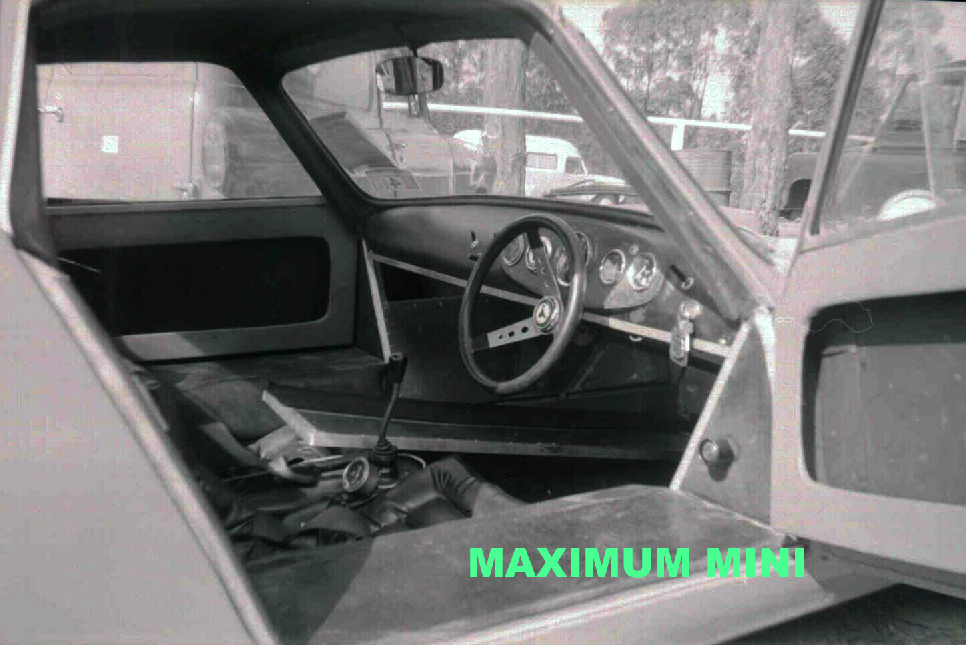
Holes in the rear end dissappeared on 'production cars'. Engine was difficult to reach

The simple lay-out of the dashboard. Note wide sills, making interior even tinier

Thursday, 16 June 2011

Derivatives meet in Switzerland

Every year Mini owners gather around for the IMM: the International Mini Meeting that took place this year in Switzerland. I wasn't there last weekend, but collected some pictures from the web of the Mini derivatives that did make it to the event. Question is: where were the Swiss Stimsons?

You may recognize Aurelien Bini's lovely Mini Jem Mk2 from my book

The Gulf paint scheme remains popular. Here on a German Mk4 Mini Marcos

And another Mini Marcos Mk4 from Germany that made it to Switzerland

How about yellow with green on a Mini Marcos Mk3? It is from Switzerland

Clean lines, no opening tailgate. I would say this is a very desirable Marcos 

A nice Domino Pimlico on a sunny day. Why not open the roof top?

That's better. This Mini Mk2 seems nicely converted. A Crayford perhaps?

Not just a short Moke, this is a French Schmitt. Perfect for a hot day in Saint-Tropez 

Ideal for Swiss mountain roads? A Scamp Mk2 with picknick place at the rear

Monday, 13 June 2011

Minis at Le Mans: 1964


So Le Mans 2011 is finished with another Audi win. Not particularly exciting isn't it? Let's have a look at the French endurance race of 1964 when adventure rather then money ruled at the La Sarthe circuit. We have seen that 1963 brought plenty of troubles for the little Deep Sanderson team (click here if not), but Christopher Lawrence and his team were detemined to return the next year, and did just that. For 1964 there appear to have been cars with number 40, 42 and 66, but in fact the first one was the car that was entered for and driven by Lawrence on the Le Mans test day in April, where it did well. For the actual race on June 22, two cars were entered and they were both equiped with Downton tuned 1295cc engines that were finished much too late and had to be installed hastily just days before the race was to start in France.

One of them was to be driven by Lawrence himself with Morgan racer Hugh Braithwaite (No.42) and the other by Christopher Spender and Eamon 'Jim' Donnelly (No.66) with Gordon Spice as back-up for both cars. But things did not go to plan when Braithwaite gave up after only having driven the car in practise. Gordon Spice wrote: "The professional (Braithwaite-JB) did precisely one and a half laps, declared his passion for life greater than his love for Deep Sandersons, packed his bags and went home!" And that was not all. Disaster struck when Donnelly crashed the No.66 car in the evening preceeding the start.

Lawrence, about the practise in his autobiography: "It took me three pit stops before I was happy to hand the car over to my co-driver, Gordon Spice. I then made an understandable but never the less serious mistake. I called Jim Donnelly in so that I could re-set his engine to the same state as mine and sent him off again. With his engine now really pulling and the 1295cc's extra torque very much in evidence, the car's acceleration away from Arnage was truly sensational which resulted in Jim arriving at Whitehouse about 75mph (120kph) faster than on any previous occasion. Whitehouse, for us, if you got it dead right, was just about flat but on this, his first attampt, Jim did not get it quite right enough, and he went off the road and totalled the car. He himself was fine."

That left the Deep Sanderson team with just one car that was hardly run in properly. It was now decided that Lawrence and Spice should race the No.42 car. Gordon Spice, who made a great racing career, said many years later: "Forget about testing it before the race, we all knew that straight out of the box we had a winner on our hands. Just to be sure, however, I was voted to shake the new car down on the drive from Le Havre to Le Mans, followed by the rest of the team in a Mk VII Jaguar with trailer and spares. After the second spin, caused by pretty basic suspension problems (so I claimed), it was decided to pick up the pieces and put the car back on the trailer. The three-lined French roads were no place for our Le Mans contender! (...)" "Talk about luck. Here I was at the tender age of 24 with all of a dozen or so club races behind me, now with a confirmed drive at Le Mans in a class winning car! We managed to qualify the car during the last session of the second day's practise. And then the great day arrived. However, my joy turned to despair when, less then an hour into the race, Chris brought the car into the pits with a blown head gasket and out of water. I thought it was the end of the world: how little I knew about endurance racing!"

Lawrence writes in his autobiography that it took him longer than that: "About five or six minutes into my third hour - we could still do four hours - the water temperature, which had been dead steady on 88 degrees Celsius started to rise and quickly went off the clock, clearly caused by a blown head gasket, so I limped back to the pit. With over an hour and a half before we could put any more water in it, even if we had changed the head gasket, we were effectively out of the race. Altogether a pretty dismal eight days."

Le Mans test day on 19 April 1964: Chris Lawrence and his own car wearing No.40

No.40 Deep Sanderson in the pit street on test day. Despite rain the car behaved well

At the straight speeds were said to be even higher then in '63 due to bigger engine

Le Mans 24 hours 1964: No.66 on the weighbridge, it now came with 1295cc engine tuned
 by Downton but delivered far too late and thus not run in 
Picture: Beroul

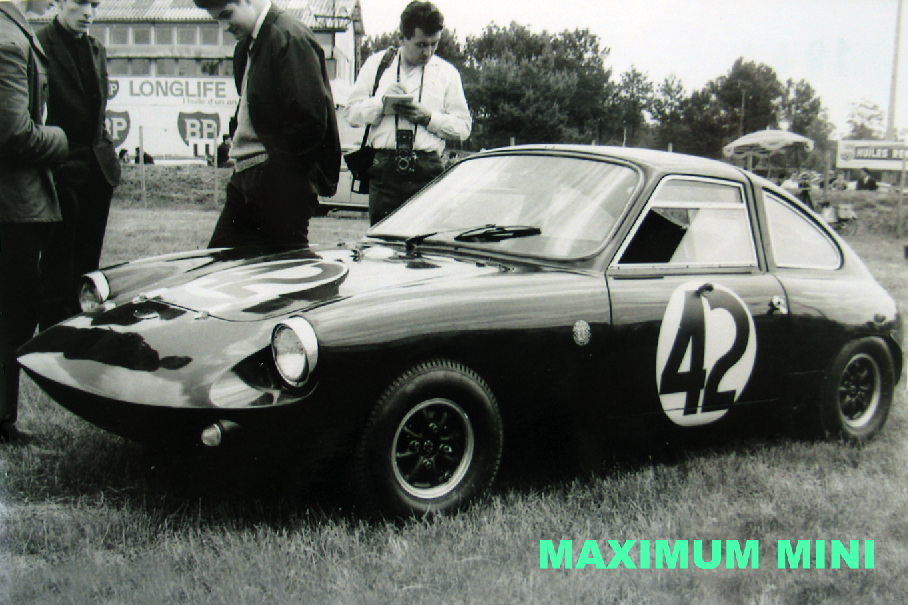
And its sister car at the same day: Deep Sanderson No.42, to be driven by Lawrence and Spice
after racing driver Hugh Braithwaite had given up after a lap and a half

Disaster strikes when Donnelly crashes Deep Sanderson No.66 in the night preceding the race
in Whitehouse corner. Note aluminium body work: this is no fibreglass

Fortunately No.42 does make it to the start. Note next to tiny Deep Sanderson the big
Shelby Cobra coupe that came in fourth overall. David and Goliath? 

Le Mans, 22 June 1964, 16:00 hours. Lawrence runs towards his car. It did not finish
Picture: HagertyKnowsClassics
Saturday, 11 June 2011

Le Mans movie clip

You have read the story of the Deep Sanderson No.44 that made it to the 1963 Le Mans 24 hours race (click here if not). With the 2011 race going on right now, you may want to see it in motion too. Well, all right, just give another click here for that.
On Monday I will have a close look at the Deep Sanderson's revenge at Le Mans in 1964 with previously unseen pictures. I may assure you it will be more exiting then this year's race!

Oof! That's a near miss with the Ferrari 250 GTO of Ecurie Francorchamps!

Friday, 10 June 2011

Was Alto Duo meant to be electric?

Yesterday, I received a message from the ever enthusiastic Jacques and Emilien Pillot, the French father and son duo that are much into Mini derivatives and own a couple of rare cars over in France, of which they say it is a real pain to import them. Never the less they keep on collecting unusual stuff from the United Kingdom and have in fact now just picked up a rare Alto Duo. Jacques wrote: "Good day Jeroen. I have sent you a serie of photographs of the Alto Duo that I bought in Great Britain. It is a Smart of fifteen years earlier! (length: 2.49m, width: 1.53m; height: 1.54m). It was originally designed to be an electric vehicle and in one of the pictures you can see the location of the battery tray below the floor (this picture comes from the restoration record)."

In fact I am not sure whether the Alto Duo was specifically designed to be an electric car as early brochures, impressions and test reports of the car that I have all mention it just to be Mini based. Fact is, however, that at least one Alto Duo was specifically built as an electric car. That particular Duo is said to have been used for a record attempt on the M25 ring road in the 1980s, but I have never been able to find out out more about that. I did find what was left over of the supposed record car a couple of years though, but it was not more then just the body. Who knows its real story?

UPDATE 5 July 2011: The real story has come to the light. Click here to read it.

The Alto Duo of the Pillots that is now in France
Picture: Jacques Pillot

Despite Mini engine, the chassis may be made to carry batteries, too
Picture: Jacques Pillot

Body of the electric Alto Duo 'record car' that I found a couple of years ago
Picture: Jeroen Booij

Wednesday, 8 June 2011

Minis at Le Mans: 1963


One of the bravest efforts at the Le Mans 24 hours race, in my opinion, has to be that of the 997cc Mini powered, rear wheel driven Deep Sanderson 301, designed, built and raced by Christopher Lawrence himself with co-driver Christopher Spender. 1963 Was the first year the little team made it to the French endurance race and two more were to follow. I found quite a few pictures of Deep Sandersons at Le Mans and it took me a while to find out which cars drove when, but for 1963 it is pretty straightforward as the team did not go to the test day in May and clearly showed its numer 44 during the race. Another 301 was entered and was supposed to be raced that year, wearing number 45, by the French 'Equipe Lausannoise' of Renault tuner Bernard Collomb, but it never made it to the track. Most fragments below are from Lawrence's autobiography 'Morgan Maverick' and give a wonderful sense of the event.

"Strangely, we had no troubles with the the scrutineers, being the only English car in the 1000cc class with three Alpine Renaults, three René Bonnets and two Italian Abarths. We had no real problems during practise either, except for a total refusal by the car to steer properly in a straight line. It was really very good in the corners but along the straight it was truly awful. Nothing we did seemed to make any difference and I suppose we slowly got used toit and got on with it. (...)"

"I did the first stint obviously, lasting for four hours. 21 Gallons, 1000cc, drag coefficient of .29 and a frontal area of eleven square feet saw to that. The car could do 150mph plus along the Mulsanne straight. It had been timed during practice through the time trap about a mile after Les Hunaudières café at 152.6mph. I brought the car into refuel at eight o'clock and handed over to Christopher in 37th place out of the 52 cars that started. Unfortunately, Christopher put the little car firmly into the vast sandpit on the outside of Mulsanne corner on his first lap. He had arrived there going very fast, braked too late, and just slid off the road into the sand. (...)"

"With its 10 inch wheels and low ground clearance, trfying to drive it out immediately burried the rear wheels until the engine and under body were just sitting on the sand, and although he tried everything he could think of to get it out, including digging away the sand from beneath the car with his bare hands, he was getting nowhere. We were getting a blow by blow report from our signallers who were right opposite the action, totally unable to do anything but hope."
"Salvation came in the end from a kind corner marshal, who threw a decent sized branch off a nearby tree to Christopher, who was able to use it as a lever to force the car onto former ground and then away back to the pits. (...) We found nearly everything full of sand, including the rear brake drums, which were just stock Mini. We did our best to clear things out but with so much time allready lost, I was keen to get going again."

Lawrence continues the race and describes comprehensively how he managed to go on racing the Deep Sanderson, even when the brakes have stopped working. At 00:30, eight and a half hours after the race started, he was supposedly lying 40th. At 4:30 in the morning he writes he was 26th and second in the 1000cc class. But then he was flagged off as the car had been behind its minimum average speed at midnight. Lawrence writes: "The rule was that all cars must maintain a speed within 10% of the leader of the class, and this is checked every four hours. They said they had checked our speed at the time but in retrospect, minimum average had not been achieved at eight hours in. (...) Obviously, we probably were well off the pace at the midnight check time, but why had they waited untill nearly 12 hours later to take any action? Could it be that we might actually win the 1000cc class, normally the preserve of the French tiddlers (...)? In actual fact, no one won the class, as no 1000cc cars finished. The number 50 Alpine went out at 14:00 hrs on Sunday with a broken con rod. So the 301 was the only running 1000cc car left at four o'clock on Sunday, but that was locked up in parc fermé."
But the Deep Sanderson team was to return the next year. Watch this space for that story.

PS: I have seen pictures of the car in the sand pit but am unable to find them at the moment. As soon as I do find them I will post them here.

The chaps of Downton engineering seem happy after having installed the 997cc engine


A lot of racing is waiting, or so they say. The Deep Sanderson in Le Mans' parc ferm
é 

And here the Deep Sanderson 301 can be seen on the weighbridge, I wonder what it weighed

I think it's being pushed to its starting position here. A traditional Le Mans start that is
Picture: Maurice Gates

The Deep Sanderson 301 in the pit street with the rear section open, showing the Mini mill with SUs

Chris Lawrence behind the wheel of his own car coming out of the Esses. A dream come true?

Rare picture of the car at full speed at the Mulsanne straight. It was said to do 150+mph there

Bad luck at Le Mans. The Deep Sanderson slid and had to be dug from a sand pit
Update: seconds after this picture was taken No.44 was caught on film. Click here

Monday, 6 June 2011

Love from Rome

How cool is this?
One of the better Mini derivatives that I have seen offered for sale during the last years was this particular Ogle SX1000 that spent most of its life in the US. Presumed to have 48,450 miles only on the clock and certainly in a very authentic looking condition, it looked like a time-warp to 1962. Where better to end up next then in Europe's most historic place? Yep, it went to Rome! See here.
The new owner writes: "On monday my Alfa 156 daily driver spewed oil from the servo steering and I put the Ogle into action for three days while the Alfa was being repaired. This included two trips to Rome, about 13 miles from my home, in 30 centigrade temperature. She ran beautifully and never missed a beat! The Ogle gets a lot of attention in Rome as nobody has literally (ever) seen one!"
Congratulations to the new owner and thanks to bringatrailer.com for sharing the pics.

Who wants to go and see the Mille Miglia when this drives in central Rome, too? 
Picture: bringatrailer.com

Historic car, historic back drop. Note cool Californian black plates
Picture: bringatrailer.com

Friday, 3 June 2011

Bitten by the Bison (3)

Been sitting in the garden, reading motoring magazines, lately? Our man Buffalo Bill definitely doesn't hang around like that! He wrote:

"I have removed the Weber for now, it is so over cammed that its impossible to shunt around the garden with it on, it needs a good strip and clean as it will tick over but with any throttle load it just stalls - a pair of slave twin SU's are in place and let it start and run fine - handily the bar that links the rear towers unbolts (which I had to do to allow the jet tubes on the carbs to fit) and rebolts 1" lower down - handy! The clutch is done and it's better than it was before, but still heavy - something to do with the shorter pedal providing less leverage I guess."

Weber carburettor has temporarily been swopped for a set of twin SUs


"I have also removed the exhaust, it was so loud the neigbours had started to 'mention' it, so for now its got a recycled RC40 box just to keep it at a more reasonable level - it's got the getto outside the body work look, but it works and will pass an MOT with it - I had to remove the black portion of the rear to repair it anyway, so now great shakes - it is a bit vile, but will do the job. I have won an Elise backbox on ebay, so may be able to make that fit. The problem is that the exhaust is limited by the boot shape - the boot needs to be fitted to hold the Targa top."

" I have also got the glass ordered - it was financially enlightening!! The people who make the glass said that the problem with mass produced car glass is that it is cheap because they make so much, and when I told the guy that the side window (which was the expensive bit) was from a one-off car he just went 'Oh, that must have cost the original owner a fortune to make...' It has to be CNC-cut because of the shape around the pill box electric windows - I've had it all remade in the correct light bronze tint as well, which cost a bit more. Igot the glass out tand can now retrim all the dash and pillers, then get the new glass back in the next couple of weeks. I have also started on the pop up lamps and used a MX5 motor in a bodged bracket to make sure it could lift the mechanisim, it did at a furious speed, so I have bought a complete pair of MX5 set up to try and use one to control both lamps - anything will be better then the shakey slow noisy motor that was in there before."
Exhaust, too, is a temporary fitment. Elise box may be better

"Then there's the tyres. These are pretty critcal as anything lower and the front spoiler scrapes on the floor due to the huge distance between it and front wheels - also the tyres need to be pretty chunky to match the wheel arches. I found a set of over 30 year old tyres on ebay that sold for over 200 euros!! I've now found that Avon do a CR500 245/50/13 which is about as near as I can get. They are well expensive (and on back order...) but I think I have found a part worn pair. Annoyingly Avon don't do a 205/60/13 to do the front, but there are plenty of tyres avalible in that size."

That all sounds as if it won't be too long before the car is on the road again. What is our man going to do then? He says: "If it drives okay I will keep it, if its an understeering deathtrap it's going!" Watch this space.

Wednesday, 1 June 2011

Minis at Le Mans: 1962


It's June, and in motor sports circles that means 'Le Mans' is under way. This is the first part of a series about Mini derivatives that made it to the legendary 24 hours race. Or, well, who attempted to do so as the very first Mini based sports car meant to tackle the French endurance never even made it to the circuit de la Sarthe. It was Gordon Fowell of West Bromwich who entered his Gitane GT in the experimental one-litre class in the 1962 race, starting on June 23 of that year. The pretty aluminium bodied Gitane, named after the French cigarette, had only just been finished with an 887cc 84bhp Mini-engine at the rear. It used wire wheels which did not give a clue to its Mini-motorisation while suspension used coil springs although the idea was to use the Mini’s original rubber springs for production versions.

Production was to start later that year, but first Fowell wanted to promote the car with a comprehensive racing programme and he entered it not only for Le Mans, but also to that year's 1000 kilometers of the Nürburgring in May and the Trophée d’Auvergne in July. Fowell was to drive the car himself with London-based car dealer Dan Margulies as a co-pilot. But Margulies, who passed away in September last year, told me he never even saw the car when I spoke to him a couple of years ago about the Gitane. The car was sold to the brother of the man who helped Fowell build it, who raced it throughout the 1960s. He sold the prototype in 1968 'to a chap in Devon', but it never reappeared. Gordon Fowell passed away at 62 in 1999 but had a stake in a few more racing cars. For more information and cool pictures of the Gitane GT you will have to buy my book, I am affraid.

Original sketch for the rear-engined Gitane GT shows an extremely low sports car. This is
years before the Unipower GT came to life but there are some definite similarities

This is a picture of the clay model. Note the sketching on it that was done by
Gordon Fowell who clearly found the design not low enough

And that's what the prototype looked like when finished. This could have been fun in between the
big Ferraris. The last trace of it dates from 1968 when it went to Devon

Not a Mini derivative but the famous Morgan Super Sports that won the two-litre class in '62. It lead to a string of Le Mans entries for driver Chris Lawrence who returned the next year with his
Mini powered Deep Sanderson