Imagine this: a car, which was restored in the UK many moons ago, can now be found in a workshop at the other end of the world where they speak a different language, eat sushi and are carrying out another restoration. This all to get it ready for our Blyton Park event in May (details here). I am very happy to have it on the Maximum Mini display, together with a range of other exiting Mini derivatives. More to follow.
Broadly speaking this will be a stunner. And you can see it in the flesh in May
Endurance rally mastermind Philip Young died yesterday in a hospital in Bangkok after the injuries from a motorcycle accident during the Road to Mandalay classic rally. Young started his impressive rallying career as a driver in a Magenta, which he built up himself from Mini and 1100 parts, for the the London to Sydney Marathon of 1977.
Last year he told me about the car: "The Magenta actually came second in 1976 in a National rally championship around the UK called the Car & Car Conversions Rally Championship, it was leading until the last round and finished second, beating Ford Escorts and other hot rally cars. It was a popular tough reliable club rally car on the UK club scene with its separate chassis, a buggy type body that used the MG1100/1300 suspension, radiator grille, brakes, engine and some other parts. I drove the car with John Corner in the 1977 London to Sydney and was jailed for going up a street the wrong way in Teheran, but then went on to India single-handed with John Corner and missed the boat sailing out of Madras with the rest of the rally…"
"There was a rival, a Mini 1275 Clubman, entered in the rally by a couple of journalists. The co-driver was Simon Park who was a music composer, who scripted a theme tune for a very popular TV detective series called Vandervalk, about a Dutch detective, it was a catchy tune (click here-JB) that went into the hit-parade here in the UK. He drove the Magenta a lot as they all took turns after I went to jail, and he has written a book about the adventure, called A Little Goes A Long Way. The car still survives today."
I showed him this posting about his old rally beast with Magenta instigator Steve Johnson next to it and he immediately replied: "Wow, I wouldn’t have recognised him. He was not the easiest person to work with, everything took twice as long as he originally promised, it’s a wonder it ever got built!"
One of many newspaper reports about Young's Magenta in the London-Sydney marathon
Picture Jeroen Booij archive
"It’s a wonder it ever got built" said Young, here in rally jacket behind the Magenta
Picture Jeroen Booij archive
And they are off! Young's Magenta had already been tested severely in rallying
Picture Jeroen Booij archive
UPDATE 15:00 : Alan Barwick writes: "Just to let you know the car that Philip Young drove is now owned by Steve Johnson's son, and so it's gone back to its roots." Thanks for that Alan.
It appears that Spain has had its fair share of Mini derivatives. We know there was this Unipower which also appeared in a funky movie, there have been some Broadspeed GTs; about a year ago we reported about the Mini Jaba found in a derelict state, while there was also a rare AMC Cub six-wheeler. Then there was a Spanish Mini Beach Car and there were a couple of Scamps owned by King Carlos. More recently a nice coachbuilt Mini emerged in Barcelona.
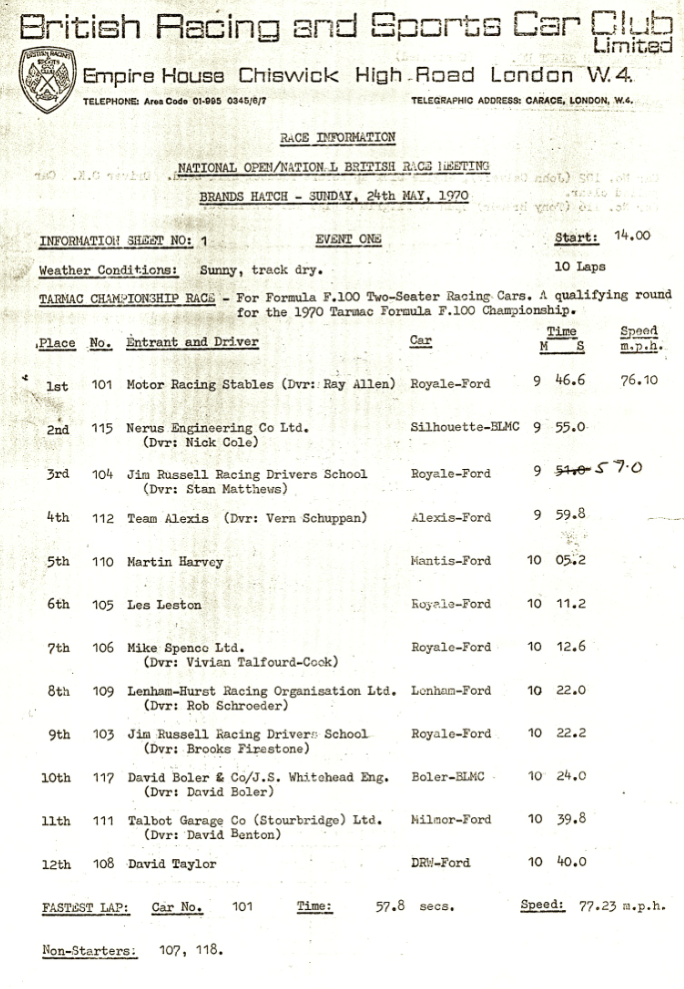
Avid reader Peter Camping now comes up with a Landar R6 that raced the Montjuich circuit during the Barcelona 12-hour race of October 5, 1969. Peter writes: "The Landar is named GT but I assume it's an R6. I found out about it as I was looking for more information about an F100 car which mentioned a certain David Boler with a car named Boler-BMLC (see scan). I found out that he drove this Landar in Barcelona. On your blog of 27 September 2012 I also noticed a D.E. Boler who raced a Cox GTM (see here) and I also recall reading about a Boler winning a North Yorkshire championship with a GTM - the same man?" The Landar, an R6 indeed, was raced together with a J. Stuart Whitehead.
Remarkably, not one but two Unipower GTs were entered to the same 12-hour race. One of them was a works car driven by Piers Weld-Forester and Robert Hurst, another a privately entered car driven by De Agustin and Alvarez. The latter did not arrive on racing day, while the works car did not finish the race. Also interesting is the Nerus entered Silhouette-BLMC mentioned on the 1970 Brands Hatch race sheet, as that car is linked to the Camber and Maya GT (see here). Thanks Peter for sharing these very interesting pictures. Wouldn't it be nice to find out more about the Landar?
The Landar R6 of David Boler and J. Stuart Whitehead in action at Montjuich
Picture via Peter Camping
And here about to overtake (?) a Costin Nathan sports car - similarly rare!
Picture via Peter Camping
Note that the Boler/Whitehead Landar R6 has a much-modified front end
Picture via Peter Camping
Boler came 10th at Brands. Nerus Silhouette-BLMC is interesting, too
It's Barry Stimson's birthday next week - about time to share another of the many great tales he told me. This one is about a Mini based sports car that never was. But also about the approach that is so typical of Barry. You'll have to love him for it!
"A man called Cooper also came round to the Nissen hut in Chichester where I was building the Mini Bug. I can’t remember what he drove but the car was definitely posher than mine. He’d heard of what I was doing, and I asked him what he wanted. I’m not a name dropper and I honestly didn’t know who he was, which made the conversation go really strange. He had planned to meet me and said his name was Cooper. ‘Like the car’, I said and he said yes. I wasn’t totally sure if he was John Cooper but we had a nice chat. He told me about his twin engine Mini and I said that it sounded dodgy to me. He then said he wanted to build a Mini based sports car and had a sketch that he’d like to show to me. He came with something on a rough piece of paper. Not a beer mat or a serviette, but definitely not a blueprint. ‘What do you think of that?’ he asked. By the way, he was talking it sounded like it was something done in the pub. I said it looked okay but there was something not quite right about it. It looked a bit like the Biota. Yes, that and a cross between the Deep Sanderson. It wasn’t horrible but he wasn’t happy with it and asked if I was interested. ‘Would you like to do it?’ he asked. I said I was quite busy. We chatted on and he seemed really nice and friendly before he went. That would have been the first day we were in Chichester and he would have been 40 or 45 at the time. It was only later that I was told it was the John Cooper. I didn’t follow it up as I was already doing things I wanted.”
What do you get when you cross a Deep Sanderson and a Biota? A Cooper perhaps?
Pictures Jeroen Booij archive
Barry Stimson at the farm in Chichester in a six-wheeler prototype. More on that later!
The sad news of the passing of Jem Marsh reached me this morning. Marsh, co-founder of the Marcos cars company, died two days ago at his home at the age of 84. Marsh certainly was one of the great characters of what is often described as the golden age of motor sports. He was a racing driver, engineer, team manager and of course a motor manufacturer, who came up with the very clever Mini Marcos in 1965. His Marcos Cars may have led a troubled life, but it could not detract Marsh from continuously giving it anew leases of life with lots of flair and he was involved with his cars until his death. The Mini Marcos most famous hour may have been its Le mans entries in 1966 and 1967 (stories here and here). Marsh' death means the end of an era in what may be called the most important chapter of Mini derivatives' history.
Jem Marsh (with tie) and his father behind the first Mk3 Mini Marcos in 1966
Picture Jeroen Booij archive
Jem Marsh and Alex Moulton at Jem's 80th birthday party, 4 years ago
The Ibis is a bird, right? Not necessarily. There have been planes, bikes and hotels named Ibis. Plus a Mini based car hailing from New Zealand. It was initiated by Wallace McNair who restored classic cars in Auckland when the good old Berkeley T60 all of a sudden sparked his idea for a Mini based sports car. But it was Ian Byrd (what's in a name) who actually turned it into a prototype. When that was destroyed when it fell from a truck Byrd nearly gave up, but fortunately Tim Monk-Masen came around to give him a hand. Under Replicar Developments (NZ) Ltd they actually build it. I will write the Ibis' full and enjoyable story for Maximum Mini 3.
But meanwhile Ben Taylor surprised me with some unseen film footage of the late 1980s. Ben says his father owned no less than three Ibises and his current car (the red one below) is supposedly one of just three on the road today. The marketing video can be found below, enjoy it and thank you Ben!
Great marketing video to promote the 1987 Ibis by Replicar Developments Video courtesy Ben Taylor
The first Ibis sports cars can also be seen at speed in the film footage Picture courtesy Paul Wilkinson
The same car made it to the stand of the Sports Car Club of NZ in 1992 Picture courtesy Paul Wilkinson
Ben's father's 1275 powered car is believed to be 1 of 3 Ibises on the road today Picture courtesy Craig Watson
Every now and then I receive a message from someone who has spotted this orange Mini Jem Mk2 looking very sad for itself. One of the chaps who photographed it some years ago published his picture and was contacted by the owner of the car who was not amused. It's not for sale nor does he want his address to be made public. For this reason I never posted any of the pictures. But now that Olof Neergaard sent over a particularly good shot of world's saddest Jem it may be about time. Olof writes: "This is why I love England! A friend was filling up his car, in the freezing cold the other day and couldn't believe his eyes: a Mini Jem parked in the grass across the road looking sad with an open side window and, apparently, a rotten interior. The big Marcos and Seven are also interesting."
I looked it up again on Google Streetview and - yes - it's still there, now joined by not one but two big Marcoses of which the first (the one on Olof's picture) has been there for several years now. Phoahh! Here some pictures of what the Mini Jem looked like back in 1990. It's about time these cars get some tender loving care. And if that is too much asked, put it under a cover, or roll it into a shed!
This Mini Jem Mk2 has been left rotting for many years now and is spotted regularly
Picture courtesy Olof Nigård
Some years earlier in Summer… This was a very nice Mini Jem back in 1990
Picture courtesy Arthur Jackson
I'm not giving the address but this is how it can be seen on Google Streetview today
After last year's first track day for fans of early Minis and Mini based cars, the time has come to get ready for the 2015 edition! The second Mk1 Performance Conversions / Maximum Mini Action Day will once again be held at Blyton Park, Lincolnshire, this time stretching over the weekend of Saturday 2nd & Sunday 3rd of May 2015 with plenty to do and see on both racing tracks of the venue.
Full details can be found here and anyone wanting to book one of the 120 track places will find the details there, too. Drop me a line if you need details from me or if you want to put your Mini derivative on display at the Maximum Mini stand. In the next weeks/months I will do some postings about the event here, too, with some ery exiting cars and their respective owners on their way to Lincolnshire in May! Meanwhile, you may enjoy the great little video my brother made of last year's event below.
Great Mini derivatives at Blyton Park during the 2014 Action Day Video: J & J Booij
A string of unseen (to me) pictures of Peter Sellers' very first coachbuilt Mini - built by Hooper (Motor Servives) Ltd. in late 1962/early '63 - have been posted on the Stilltime pictures website. They give a new insight at the car which cost Sellers £2600 (a standard Cooper came at £679 at the time) and which caused the Mini to become a new coachbuilt favourite for use as a city car for the rich and famous. Sellers supposedly asked dealership HR Owen for the conversion, but HR Owen commissioned Hooper for the job, building what became known as the Mini to start the coachbuilding hype. The later car used by Sellers in the Pink Panther film looked similar, but was in fact another and later car coachbuilt by Radford.
The original Hooper car, registration '6189 PK' came lavishly trimmed inside and out, with Royal Purple paint and a beige Conolly interior - the exact specs can be found in the Autocar article I have attached. Despite the fact that several pictures of the car have been around, even some film footage, I never noticed it had wheel spats and new rear light clusters, possibly cut-down Aston Martin DB4 units. Confusingly, the car is seen wearing another registration number (57 PJ) and a red rather than beige interior in another Autocar clipping, while the film footage shows it with its '6189 PK' number but with red leather, too. Was it the same car converted once more or did Hooper build two of them?
And then there's the question of where it is now. The Radford-built Pink Panther car was famously found back by John Adair in 1994, but what happened to the original Hooper car (or cars)? The last lead dates back to 1994, too, when a snippet in MiniWorld magazine appeared, quoting it survived with a classic car restoration firm in Newtonmore, Scotland. It was said to have been painted pink at one stage because of the supposed link with the Pink Panther movie... The company, as far as I managed to find out, was dissolved in 2002 with no clues to what happened to the car. '57 PJ' is unknown to the DVLA, but '6189 PK' is still in their database as a mauve Morris Mini Cooper with 1152cc engine, but is untaxed since 1979...
Well-known photograph of man and machine - Sellers and his (the) first coachbuilt Mini
Picture courtesy art.com
But this one is new to me. Note wheel spats and unusual rear light treatment
Picture courtesy stilltimecollection.co.uk
Lavish interior with beige Conolly leather seats with 'Reutter reclining system'
Picture courtesy stilltimecollection.co.uk
Yes, the windows were electric on it, as was the aerial and the screen washer
Picture courtesy stilltimecollection.co.uk
Headlights were supposedly Bentley-sourced. Canework by Geoff Francis
Picture courtesy stilltimecollection.co.uk
Note replaced gear lever as in later Minis and even leather on the steering column
Picture courtesy stilltimecollection.co.uk
The Autocar liked it, too, calling it 'the ultimate in luxury Minis'
Picture Jeroen Booij archive
Is this the same car? It wears a different registration and has a red leather interior
Picture Jeroen Booij archive
Film footage of Sellers and the car, seen here in its Royal Purple with red leather interior
Picture courtesy youtube.com
Last trace of the car dates back to 1994, when it was in Scotland ...painted pink...
Before we have our man Barry Stimson himself dish up some more tales here, have a look at this. A Stimson Mini Bug, which feels rather sorry for itself, oh yes. But according to Barry Tilbury, who bought it recently, it is one of the cars that featured prominently in the 1970s television series Freewheelers. In fact he says it is the car registered RPX 885K, which can also be seen here in its heyday. We don't know, but would love to see it being restored. More information is welcome!
UPDATE 4 February 2015: Barry sent in a copy of the car's document - it's the one!
A Stimson Mini Bug, no doubt, but a rather special one to 1970s tv fans
Picture courtesy Barry Tilbury
According to the new owner the car is complete but needs a restoration