Thursday, 11 August 2011

Geoff's Ogles

Several times I have come across this chic little burgundy Ogle SX1000 and the first time when I did so it was owned by Geoffrey Hunter. Geoff liked restoring cars and he'd done just that with '889 RJH'. But when I visited him on a summer day years ago he told me he owned another SX1000 since the mid-sixties that was bound for complete restoration. In fact, the body of that car can be seen lying in his garden next to '889 RJH'. Geoff was thinking of selling the  finished car to fund his project SX. And so he did. It was supposedly sold to the son of once-Aston Martin owner Victor Gauntlett, but I saw it later when walking through one of London's mews. I came back the next morning to find it was for sale there, again, now with classic car dealer Graeme Hunt, but that is the last time I came across the car. Where is it now?

UPDATE 3 October 2012: the car is now up for auction. See here

An Ogle SX1000 plus the body of another in the English country side
Picture: Jeroen Booij

Tuesday, 9 August 2011

Scamps for Summer

Don't moan about the weather - here is the best tip I can give for having open top motoring fun on a shoestring budget: the Mini based Scamp. Hundreds were made in umpteen guises and they are still cheap to buy and run. Besides: the amount of Scamps that's been offered for sale in the last months has really surprised me. Currently you will find three on eBay (Mk2s here and here and a Mk3 here). Or is it a Mk1 that you are looking for? Then check the Scamp Owners Club website here as they come up there regularly. The Scamp club is a crazy bunch and I had fun when Chris Westgate offered me a ride in his Mk1 two years ago at Cofton Park, Longbridge. One day I will live in the country and have my own Scamp!

Good looking Scamp Mk2. It appears to be well-restored

Somewhat less extravagant Mk2. But somewhat cheaper too

Or do you prefer your Scamp as a Mk3? This one looks good

Monday, 8 August 2011

Lovely Landar images

Every now and than I receive a real treat. And when Tim Dyke sent me a stack of over 60 quality pictures from his personal scrapbook he clearly made my day. Don't think they were your average holiday snap shots, as the theme of this collection was the rare Landar R6, designed and built by brother Clive and Peter Radnall. Tim wrote: "I was lucky enough to own and race a Landar R6 - the first one in private hands, in 1966!" And when you look at the pictures you will find he was a lucky man indeed, clearly having fun racing his low-slung Landar. Here below three of my favourite shots, taken at Shelsley Walsh hill climb in June 1968. Let me know when you like them as there are many, many more. Thank you Tim!

That's Tim racing his lovely Landar R6 at Shelsley Walsh in June 1968

That appears to be the pit street reserved for number 41 -Tim's Landar

And the pit scene, seen from the other side. Hill climbing is fun isn't it?

Biota's practical buggy

Houghton Coldwell Ltd, producers of the praised (at least, by me!) Mini based Biota and Biota Mk2 (click here) did more than just produce highly eccentric open top fun cars that were to become an early 1970s icon (again, that's an opinion) . The fibreglass masters from Dinnington made all kinds of fibreglass devices to earn some money, from fishing baskets to bolt-on aerodynamic front- and rear-ends for the Mini.
But more recently I came across an advertisement from the company for another Mini based vehicle they offered for sale in 1970. It was called the Mod and the ad said: "Don't buggy about - get a Mod. The practical Mini fun kit" It was said to feature a two-way folding screen and a loading ramp tail board, so I guess you use it to easily load your lawn mawer/jet ski/refrigerator and drive it from a to b with the wind screen down. Now, that's practical! Anyone attracted to the boxy shaped buggy-sort-of work horse that the ad showed in a child-like drawing was asked to write to Houghton Coldwell for full details. I would love to find out more about those. And did they ever come to actually produce the Mod? Now that would be even better.


More practical then the Biota - this is the Mod. Were there any produced?

Or how about this? A Biota Deluxe Camper available in 'Tangerine' and 'Tourqoise'

Friday, 5 August 2011

Camber/Maya files: HPN13D


Let's continue with our little quest for information about Camber- and Maya GTs. As you will know by now funny little creatures that I quite like, although their history seems to get more and more complicated. Proof is the car next up, a Maya GT registered 'HPN13D'. It's the car that was used in one of the Maya brochures, white in colour. As the registration number is so close to that of its sister car 'HPN14D' (see here, yes it's a Camber) I believed for a long time that this too, had to be a Camber GT as the nose with its typical frog eye headlights is not shown on these brochure shots. That is untill I came across a picture in Cars & Car Conversions magazine that shows the same car from another angle. Yep, that's clearly a Maya nose section.

I also found that this Maya was raced, as was John D. Green’s Camber GT (see for that story here). It's driver was supposedly Mike Greenwood who is said to have raced the Vandervell V8 in the 1967 season, although I cannot find any information on Greenwood at all. I have been in touch with several Mikes Greenwood by now, but not one of them knew anything about a Maya or a Vandervell! Perhaps somebody else will know? There is no DVLA description for the car now, but it won't surprise me if it does survive in the end, as several other cars have come to the light since I started these files...

The car in the brochure. Headlights cannot be seen here which made identification hard
Picture Jeroen Booij archive

And the same goes with this brochure shot. What a lovely clean interior though
Picture Jeroen Booij archive

But there we go. It's clearly the same car at the same place. And it's clearly a Maya GT
Picture courtesy Cars & Car Conversions

The Maya GT 'HPN13D' at the track. It has to be Mike Greenwood driving it. Richard Hawcroft adds: that is at Brands Hatch. It was taken from near the grandstand on Paddock Hill bend, you can just see the exit for the pits behind the 'Lucas' advert. You can also see the 'loop' of the track after Graham Hill bends (though of course it wasn't Graham Hill bends in those days!)
Picture Jeroen Booij archive

Thursday, 4 August 2011

Bulanti builder calls in!

Things can go rapidly on the net. I have been trying to find out more about the Bulanti, built Down Under in the early 1970s, for years without much result. But when I posted this article (click), some really cool replies were sent over to here from Kevin Boole (see here) and Henry Draper (see here), unspinning great tales about the dartling Bulantis. This time it gets even better, as Bulanti designer and builder Brian Rawlings calls in from Australia! Brian writes:

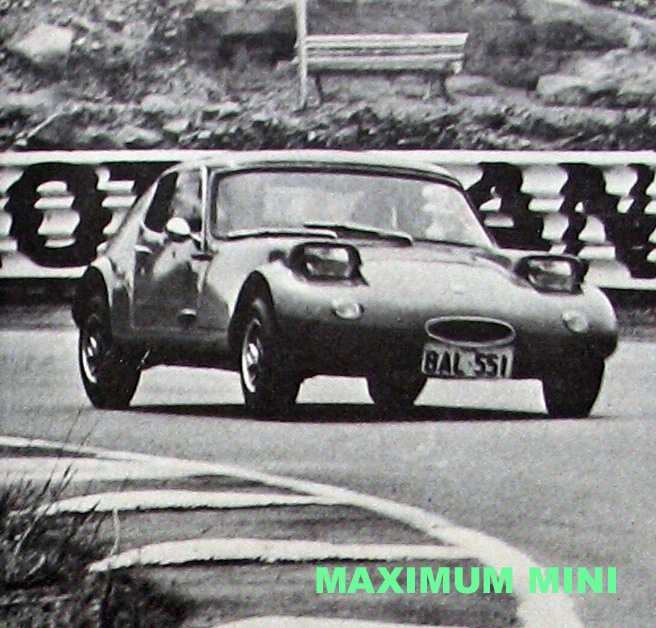
"Hi Jeroen. A friend sent me the article on the Bulantis. I am sorry to hear Graham had passed away, he was a really nice bloke and a true gentleman. I built the cars and BAL 551 was the aluminium prototype, Grahams green car was number 2 and I remember making the manifold for the turbo. The photo of the red car was taken the day of the mag article from the control tower at Amaroo Park car track, me in the car I think and my dog Bo." (click here to see both car and dog)

"I have read your book and thoroughly enjoyed it. Thanks for including the Bulanti in the book. Incidently the cars before the coupes were called Bulants and a couple of French flower growers I knew saw the prototype being built and said it needed to sound more continental and exotic so hence the 'i' was tacked on. There were only three coupes built; red, green and a brown car which clobbered the wall at Amaroo Park during private practice. It was repaired and then sold. I went back to building clubman sports cars for racing, similar to Lotus 7 type vehicles. I read the three cars went to Melbourne but I don't know any more than that. Regards, Brian"

And a bonus picture of the Bulanti at Amaroo Park raceway 

Thursday, 28 July 2011

I need you for Maximum Mini

Ladies and gentlemen, I need your help.

For my next visit to the UK I could do with another one or two (or three) photographable cars. There are quite a few really rare machines that I am still chasing, but meanwhile there are some more, ahem, regular ones that I'd like to have featured in the next book, too. However, so far I haven't been able to track them down. See them in the list below in alphabetical order. If you happen to have one of these, or know somebody who may know somebody who owns one, please get in touch through the comments below or at jeroen@jeroenbooij.com

ABC Tricar - yes, the three-wheeler, see more here
ASD Minim - according to its builder 7 were built, see also here
Beaver Mini - again 7 of them were around at one time, see here
Boxer Sprint - at least one was built as shows the brochure
Brookwell Trifid - four made, but are there any survivors?
Elswick Envoy - plenty of them made, but who has a proper one?
GTM Rossa Mk1 - I only see Mk2s - the earlier cars seem rare
Heerey GTM - these should be around in the UK. Who has one?
Magenta - I prefer the Magenta Sprint but like the 1100 based one, too
MDV Van - I have seen pictures of a few, but not one in the flesh
Mean Sonora - Do any Mini-based Sonoras survive at all?
Minus Maxi - And did anyone ever see one of these lately? Pic below
Navajo - Again 7 were built. The one that I know of is totally dismantled
Onyx Tomcat or Bobcat - There should be plenty of these around
Ranger Cub - These seem much rarer then the supposed 200 built, pic below
Seagull - At least one was made, and that's the one in the brochure, see below


Who could not love the 3-wheeled Ranger Cub? I need one to photograph

Mini based Seagull. It's strange, it's rare and I'd be dead keen to see one

A Minus Maxi. On the web you can find a blue one too, but who owns one?

Minimach returns to Sicily

We have seen period pictures (here) and even a lightning fast bit of film footage (here) of the ESAP Minimach during the 1968 Targa Florio at Sicily, but isn't it nice to know that the car returned to the island last Summer, too? Current owner Stefano took the car to Sicily for the Ruote a Raggi Rally to drive the same twisty road circuit that it did over 40 years ago! Keti Padoan, youngest daughter of ESAP founder and Minimach builder Gianfranco Padoan was there too, driving an MG TD.

Palm trees, sun and a rare Mini derivative. That's Keti behind the wheel
Picture courtesy: ruotearaggisicilia.it


And another shot of the ESAP Minimach 40 years earlier when Keti's father drove it at Sicily

Tuesday, 26 July 2011

Minis at Le Mans: 1969


This is the last in the Le Mans series as no Mini powered cars made it to the French track after 1969. That year, a Unipower works car was entered to the endurance race. Production for the Unipower GT was taken over a year earlier by Piers Weld-Forester who began to concentrate on a comprehensive racing publicity campaign. He had three light weight works cars built and entered one for the 24-hours race of Le Mans in June 1969. The car is said to have been built with a special ultra light carbon fibre body by Specialized Mouldings but I am not too sure if that is the same car that was used at the Le Mans test day on 30 March 1969 (it was - UPDATE here). When you look at the pictures below you will notice that there are quite a few differences in the test day entry (number 53) and the actual 24-hour race entry (number 47). Number 53 did well at the test day, when it came in 24th overall. It is the car that survives today in the hands of Gerry Hulford who owns it since 1976 (UPDATE - unfortunately it does not survive but was written off in September 1970 - more here)

During the actual race in June 1969 Weld-Forester was to drive the special light weight Unipower GT together with Stanley Robinson, a customer who had bought the works racer. During practise it was reputedly clocked at 140mph on Mulsanne Straight and the French nicknamed it ‘la puce jaune’ (the yellow flea) for it being both tiny as fast. When it later lost a wheel at speed there was no serious damage, however the Unipower did not qualify for the race, probably because the time it set at practise was not enough for its class. So despite all the effort the Unipower team was never able to prove itself at Le Mans. Once again, the 1969 event was won by a Ford GT40.

Stanley Robinson kept on campaigning the Le Mans car after its maiden race, and did the 1969 Nurburgring 500 kilometres in it (9th in class); the 1970 Spa 1000 Kilometres (did not finish) and the 1970 Nurburgring 1000 kilometres (32nd overall). After that he converted the Mini based race car to Ford Cosworth FVA power and kept on racing it throughout Europe until it was written off at the Nurburgring in 1970.

The Le Mans Unipower GT is ready for testing. I think this is still in London

But this clearly is the Le Mans pit street. No mirrors for aerodynamic reasons?

And a colour picture at the very same place. This is test day on March 30, 1969

And a rear view please. Note wide arches and ventilation holes in rear screen
Picture courtesy l'Automobile

Number 53 Unipower GT came in at a respectable 24th on the test day
Picture courtesy www.lemans-photos.org

This number 47 is the actual Le Mans entry. I think it is an entirely different car
Picture courtesy Beroul

The air duct now runs along the complete front. And that's a massive spot light!
Picture sent in by Roald Rakers

During qualification the car made 140mph but unfortunately it did not qualify
Picture courtesy www.lemans-photos.org

UPDATE 27 February 2013: More insights and details about the Unipowers at Le Mans. Click here

PS: Drop me a line in the comments below when you enjoyed my articles about Minis at Le Mans. I may be tempted to do a similar series for Mini derivatives in other famous races or at other famous tracks as I have so much more material. See for the other posts in this series:


Monday, 25 July 2011

Deep Sanderson makes healthy price

It's been sold: the aluminium bodied Deep Sanderson 301 that was auctioned this weekend (more here and here) at Silverstone Auctions' inaugural sale. Not for the 46,000-50,000 price that was estimated, but for 40,000 pounds. Still enough to become the best paid-for Mini derivative that I know of. The seller believes it could have made more, but is happy with the price that was paid for it in the auction as the market is considered to be weak at the moment. He says the car is bought by a European man, based in the UK. It will remain in its home country and will be raced regularly in the future, too. That's nice.

UPDATE 2 August 2011: Now that the auctioner has published their results it appears that the car did not make 40,000 but 36,000 pounds. The seller wrote to me to explain: "The hammer price was £36,000. You then add 10% commission to that - £39,600. Then you add in VAT of 20% on that commission, giving a total of £40,320. I earned £40,000 for my car. The man ended up paying well over £41,000 when you factor in transport costs etc."

The Deep Sanderson 301 races towards a healthy price
Picture courtesy Andrew Wright